
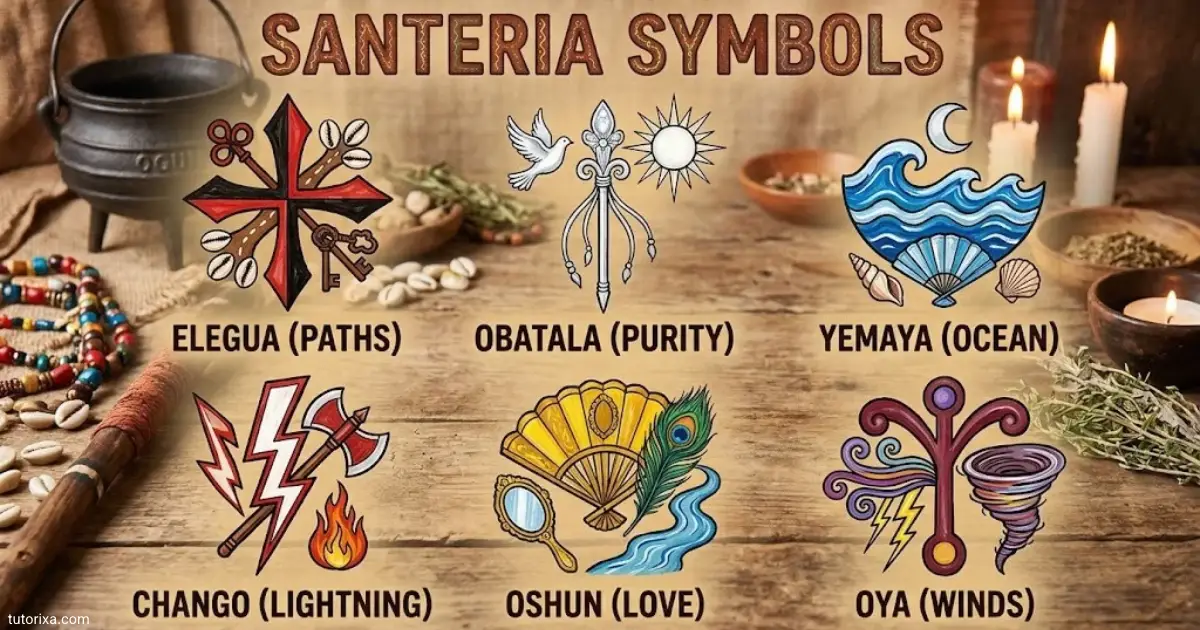
Santeria symbols offer a glimpse into a spiritual tradition built around faith, nature, music, rituals, and connections with divine beings. Many of these symbols are associated with the Orishas, powerful spiritual figures honored in the religion. Their meanings can relate to protection, wisdom, love, strength, healing, and guidance.
Santeria, also known as Regla de Ocha or Lucumí, developed in Cuba through the blending of Yoruba religious traditions with elements of Catholicism and other cultural influences. Its symbols may appear in sacred art, ritual objects, bead necklaces, religious imagery, and personal devotional practices. The meaning of a particular color, object, or emblem can vary depending on the Orisha, community, and religious context.
In this guide, you’ll discover Santeria symbols and their meanings, learn about important gods and Orishas, and explore symbols connected with protection and Cuban traditions. You’ll also find related Voodoo and Mexican spiritual symbols, with clear explanations of where traditions overlap and where they differ.
Santeria Religion
Santeria is an Afro-Cuban religion rooted in Yoruba spiritual traditions brought from West Africa to Cuba during the transatlantic slave trade. Over time, these beliefs developed alongside elements of Spanish Catholicism and Cuban culture. The religion is also known as Regla de Ocha or Lucumí.
Santeria followers honor a supreme creator and the Orishas, divine beings associated with aspects of nature, human life, and spiritual guidance. Worship may include prayers, drumming, offerings, ceremonies, divination, and sacred objects.
Symbols are part of this religious life, but Santeria does not have one universal set of icons that every follower uses. Colors, beads, natural objects, and ritual items can carry particular meanings within specific religious communities.
Common Santeria Symbols You May Encounter
These necklaces contain beads associated with particular Orishas. Their colors and patterns may express devotion, religious identity, and spiritual relationships. They are sacred objects rather than ordinary fashion accessories.
White is strongly associated with Obatalá and may represent purity, wisdom, peace, and spiritual clarity. White clothing also has significance in certain Santeria ceremonies and periods of religious observance.
Yellow and gold are commonly associated with Oshún, an Orisha connected with rivers, love, beauty, and prosperity. Their use depends on the devotional context.
These colors are often linked with Yemayá, the Orisha associated with the sea, motherhood, and nurturing protection.
The meanings of these objects are not always fixed. A necklace, color, or sacred item may have a more specific meaning depending on the person’s initiation, religious lineage, or the ceremony in which it appears.
Santeria Gods
The beings commonly called Santeria gods are known as Orishas. They are central to the religion and are associated with different natural forces, human experiences, responsibilities, and spiritual qualities.
Santeria traditions recognize many Orishas, and their stories and attributes may vary across communities. The following table introduces some of the best-known figures and the symbols commonly associated with them.
| Orisha | Common associations | Related symbols or colors |
| Eleguá (Elegguá) | Crossroads, choices, opportunities | Keys, crossroads, red and black |
| Obatalá | Wisdom, peace, creation | White cloth, white beads |
| Oshún (Ochún) | Love, beauty, rivers, prosperity | Yellow, gold, mirrors |
| Yemayá (Yemayá) | Sea, motherhood, nurturing | Blue, white, seashells |
| Changó (Shangó) | Thunder, lightning, power, justice | Red, white, double-headed axe |
| Ogún (Ogún) | Iron, metalwork, labor, strength | Iron tools, machetes, green and black |
| Oyá | Winds, storms, transformation | Burgundy or maroon, wind |
| Babalú-Ayé | Illness, healing, suffering, recovery | Earth, healing imagery, purple tones in some traditions |
These associations are useful starting points, not a complete religious guide. Color combinations and ritual objects can differ between lineages, and not every image found online represents an established Santeria symbol.
Why Are Santeria Gods Linked With Catholic Saints?
In some Cuban traditions, Orishas became associated with Catholic saints and sacred figures. These connections developed through historical and cultural circumstances, including colonial restrictions on African religious practices.
For example, Changó is often associated with Saint Barbara, while Oshún is commonly associated with Our Lady of Charity in Cuban religious contexts. Such relationships are forms of religious syncretism, but the Orishas and Catholic saints are not simply interchangeable in every community.
Santeria Symbols And Meanings
Santeria symbols can communicate devotion, spiritual relationships, personal responsibilities, and the qualities associated with an Orisha. Some are recognizable objects, while others involve specific colors, numbers, natural materials, or ritual arrangements.
Here are common examples to help you identify their meanings.
| Symbol or object | Common meaning or association |
| 🔑 Key | May represent Eleguá’s association with opening paths and opportunities |
| ⚔️ Iron tools | Associated with Ogún, metal, labor, and strength |
| ⚡ Lightning | Associated with Changó and powerful natural forces |
| 🌊 Water | May represent the rivers of Oshún or the sea of Yemayá, depending on context |
| 🐚 Seashells | Associated with the sea and, in some contexts, divination or sacred offerings |
| 🪞 Mirror | Commonly linked with Oshún in devotional imagery |
| 🕯️ Candle | May be used in prayer or devotional practice; its meaning depends on the ceremony |
| 🤍 White cloth | Associated with Obatalá, purity, and peace |
| 🌿 Herbs and leaves | May have ritual, cleansing, or healing significance |
| 📿 Beaded necklace | Can identify a devotional relationship with an Orisha |
The emoji shown here are modern visual references, not official Santeria glyphs or traditional Unicode symbols. Their meanings are contextual rather than universal.
Santeria Symbols For Copy And Paste
If you’re creating educational notes, a social media post, or a decorative design inspired by Santeria, these ordinary Unicode characters can help illustrate related ideas.
⚡
Lightning
Thunder and Changó associations
Copy
🌊
Water wave
Sea and river associations
Copy
🔑
Key
Crossroads and opening paths
Copy
🕯
Candle
Prayer and devotional light
Copy
🌿
Herb
Plants and natural materials
Copy
🤍
White heart
A modern illustration of peace or purity
Copy
These characters are suitable for general text and digital decoration, but they should not be mistaken for sacred signs used in formal ceremonies. The appearance of emoji may also vary across devices.
Do Santeria Symbols Have Fixed Meanings?
Not always. An object can have several meanings depending on the Orisha, ritual, and community. Even color associations may have variations. Learning the context behind a symbol is more useful than assuming that every image has one universal definition.
Orisha Santeria Symbols
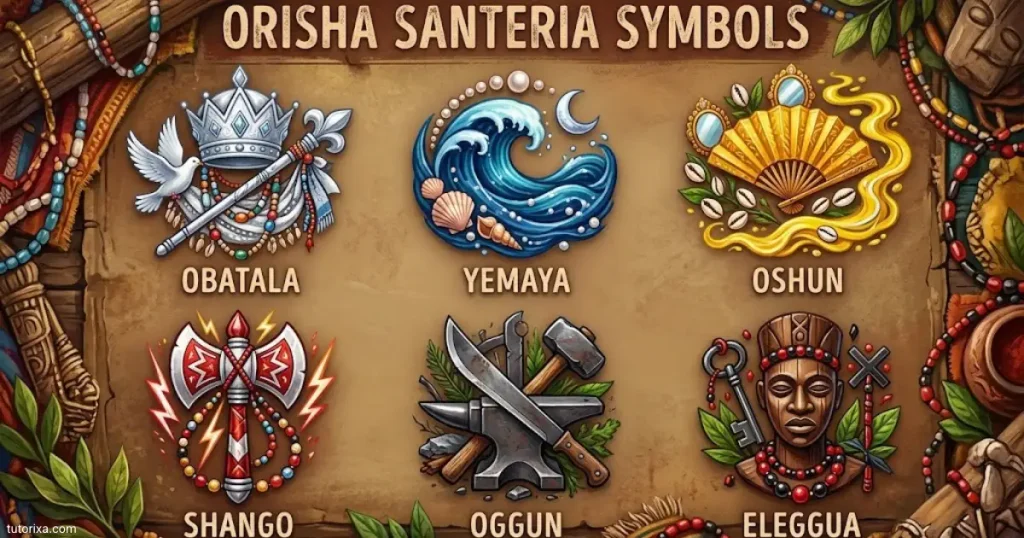
Orisha symbols are among the most recognizable elements of Santeria. They help people understand the qualities associated with individual Orishas, although traditional religious meanings often go deeper than a single object or color.
Here are some prominent Orisha symbols and their common associations.
Eleguá is associated with entrances, crossroads, choices, and opportunities. Keys and crossroads are useful visual representations of these themes. He is often honored at the beginning of religious ceremonies.
Obatalá is associated with wisdom, creation, calmness, and clarity. White cloth and white beads are widely recognized devotional associations. In some traditions, white also represents purity and peaceful conduct.
Oshún is linked with rivers, love, beauty, fertility, and prosperity. Mirrors, fans, and golden or yellow objects frequently appear in depictions of her.
Yemayá represents the sea, motherhood, and nurturing strength. Ocean imagery, shells, and blue-and-white beadwork are commonly associated with her.
Changó is associated with thunder, lightning, authority, and justice. The double-headed axe, often called an oshe in this context, is a well-known emblem linked to his power.
Ogún is associated with iron, metalwork, hard labor, and overcoming obstacles. Iron tools and machetes represent his connection with metal and practical work.
Oyá is linked with winds, storms, change, and transitions. Images of moving air, storm clouds, and flowing fabric can help illustrate these themes without claiming to be formal ritual emblems.
How To Recognize Orisha Symbols
- Look at the colors: Bead colors may provide clues about the Orisha being represented.
- Notice the objects: Keys, iron tools, mirrors, and double-headed axes have different associations.
- Consider the setting: An object displayed in a devotional setting may have a meaning that differs from its everyday use.
- Check the source: A museum, scholarly publication, or knowledgeable practitioner can provide better context than an unattributed social media image.
The bead patterns and sacred objects used in Santeria can be tied to specific religious commitments. Their meanings should not be reduced to a generic color chart.
Protection Santeria Symbols
Protection is an important theme in many Santeria practices. Devotees may seek spiritual guidance, balance, safety, or help through prayer, ceremonies, and objects prepared within their religious tradition.
However, there is no single protection symbol that every Santeria follower uses. The significance of a protective object depends on its purpose and how it has been prepared.
Common Symbols Associated With Protection
| Symbol or object | Protective association |
| 📿 Sacred bead necklace | Devotional connection with an Orisha; not simply a general-purpose amulet |
| 🛡️ Shield | A modern visual metaphor for safety, not a universal traditional Santeria emblem |
| 🔑 Key | Eleguá’s association with paths, entrances, and opportunities |
| 🌿 Sacred herbs | May be used in cleansing or other prescribed rituals |
| 🕯️ Candle | May accompany prayer or devotional observance |
| 🐚 Cowrie shells | May have ritual or divinatory significance in particular practices |
| ⚙️ Iron tools | Associated with Ogún and the power of iron |
The shield and emoji in this table are illustrative digital symbols. Their presence does not establish them as traditional Santeria ritual signs.
What Is The Meaning Of A Santeria Protection Necklace?
A sacred bead necklace, commonly called an eleke (plural elekes), may represent a relationship between a devotee and a particular Orisha. Its bead colors and arrangement carry religious significance. In many communities, receiving and wearing these necklaces follows specific guidance and ceremonies.
A necklace should not automatically be treated as a universal charm that guarantees safety or changes a person’s luck. Its meaning comes from the religious tradition behind it.
Protection Symbols For Digital Use
If you want a simple symbol for a profile, caption, or personal design inspired by the idea of protection, these Unicode characters are easy to copy.
🛡
Shield
General symbol of safety
Copy
✧
Four-point star
Decorative spiritual theme
Copy
☼
Sun symbol
Light and renewal
Copy
❖
Diamond ornament
Decorative emblem
Copy
These are general-purpose text symbols, not claims about traditional Santeria iconography. If you want to represent a specific Orisha respectfully, use a symbol whose meaning and cultural context you understand.
Cuban Santeria Symbols
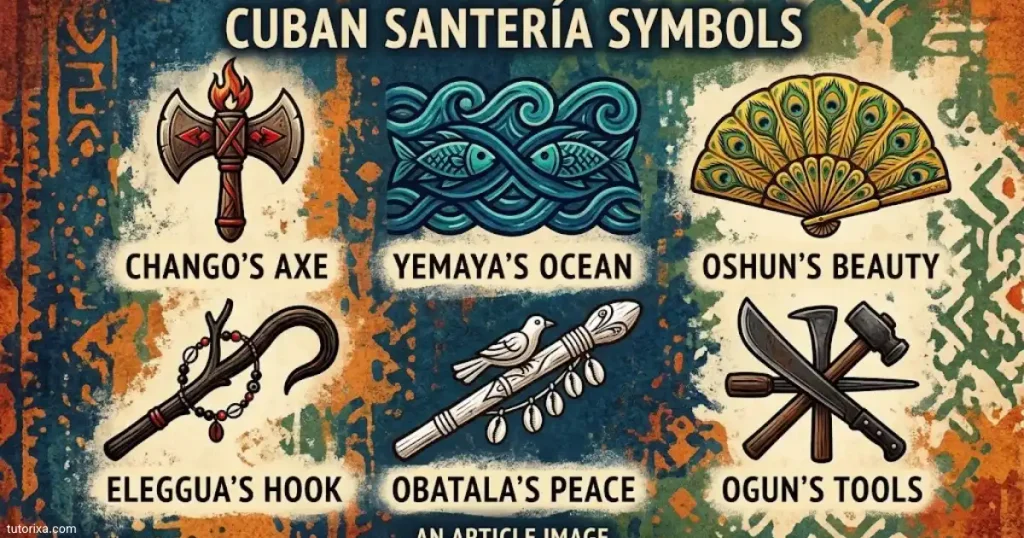
Cuba is central to the development of Santeria as an Afro-Cuban religion. Cuban traditions preserve Yoruba-derived beliefs while reflecting centuries of cultural change, including relationships with Catholic practices and other Afro-Cuban religions.
Cuban Santeria symbols are often found in bead necklaces, sacred vessels, ritual objects, clothing, music, and devotional spaces.
Recognizable Cuban Santeria Symbols And Objects
Beaded necklaces are among the best-known visible elements of Cuban Santeria. Their colors and patterns may identify an Orisha and reflect a devotee’s religious relationship.
Certain covered vessels and containers are used to house or honor sacred objects associated with Orishas. Their appearance, contents, and handling depend on the religious tradition and object involved.
Divination is significant in related Yoruba-derived traditions. The opon Ifá, a divination board, belongs specifically to the Ifá system; it should not be presented as a universal symbol used by all Santeria followers.
The ceiba holds spiritual and cultural significance in some Afro-Cuban religious contexts. It may be associated with sacred power, respect for nature, and ritual practices, although its meaning varies by tradition.
Cuban Santeria Colors
Colors often help people recognize devotional objects, but they should be understood as associations rather than rigid rules.
| Orisha | Common Cuban color association |
| Eleguá | Red and black |
| Obatalá | White |
| Oshún | Yellow and gold |
| Yemayá | Blue and white |
| Changó | Red and white |
| Ogún | Green and black |
| Oyá | Burgundy or maroon in many representations |
Color combinations and bead patterns may vary by lineage. A color alone is not always enough to identify a sacred object correctly.
Why Cuban Santeria Symbols Matter
These objects connect religious practice with family history, community, cultural memory, and devotion. They are more than decorative motifs. Studying them also helps explain how Yoruba traditions survived and developed in Cuba under difficult historical conditions.
Voodoo Santeria Symbols
Santeria and Voodoo are sometimes discussed together because both belong to the wider history of African diasporic religions in the Americas. However, they are distinct religious traditions with different histories, spiritual systems, ceremonies, and symbols.
Santeria, or Regla de Ocha, developed primarily in Cuba from Yoruba religious traditions. Haitian Vodou developed through African religious traditions, including those of Fon and other West African peoples, alongside influences from Catholicism and Haiti’s own history. Louisiana Voodoo has its own distinct development as well. These traditions should not be treated as interchangeable.
Common Symbols Associated With Voodoo Traditions
Veves are ritual drawings used in Haitian Vodou to honor or call upon particular spirits, known as lwa. They may feature lines, geometric patterns, and distinctive shapes. They are not a universal Santeria symbol system.
Ceremonial flags, sometimes called drapo Vodou, can feature elaborate embroidery, sequins, and imagery associated with particular spirits or religious communities.
Candles, flowers, food, and other objects may appear in Vodou ceremonies. Their meaning depends on the spirit being honored and the specific religious practice.
Santeria Symbols Vs. Voodoo Symbols
| Feature | Santeria | Haitian Vodou |
| Spiritual beings | Orishas | Lwa |
| Important visual elements | Bead necklaces, colors, sacred objects | Veves, ceremonial flags, ritual objects |
| Historical roots | Yoruba traditions developed in Cuba | West and Central African influences developed in Haiti |
| Religious ceremonies | Vary by Orisha and lineage | Vary by lwa and religious community |
| Symbolic practices | Objects, colors, ritual arrangements, and other traditions | Spirit-specific drawings, objects, and ceremonial imagery |
There are historical connections and shared influences across African diasporic religions, but the terms Orisha and lwa do not mean exactly the same thing. Likewise, a Vodou veve should not be labeled a Santeria symbol simply because both religions have African roots.
Mexican Santeria Symbols
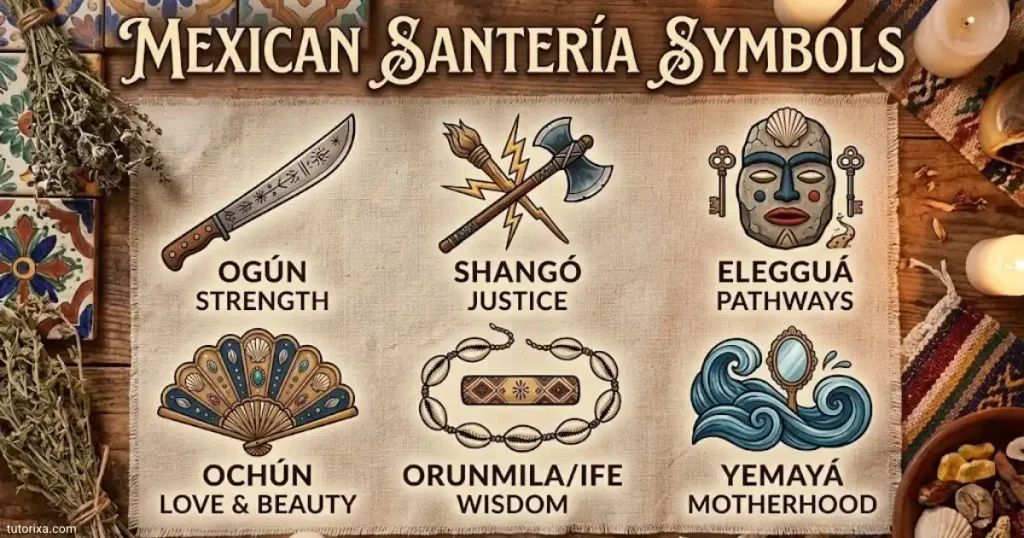
The phrase “Mexican Santeria symbols” can refer to several different things. Some people use it when searching for Santeria imagery in Mexico, while others are looking for Mexican folk-religious symbols that resemble or overlap with Afro-Caribbean spiritual practices.
Santeria is not exclusively Cuban today. Its practitioners and communities can be found in different countries, including Mexico. However, Mexican folk religion and popular spiritual practices have their own histories and should not automatically be classified as Santeria.
Mexican Spiritual Symbols Sometimes Compared With Santeria
This important Catholic Marian image has a major place in Mexican religious culture. It is not an Orisha symbol, although Catholic imagery has historical connections with some forms of Santeria through religious syncretism.
Santa Muerte is a folk-saint figure associated with death and devotional practices among some followers. This tradition is distinct from Santeria, even when people compare their protective or devotional themes.
These small devotional charms are often shaped like hearts, hands, eyes, or other body parts. In some Mexican folk-religious settings, they express prayers, gratitude, or hopes for healing. They are not inherently Santeria objects.
Can You Find Santeria Symbols In Mexico?
Yes. People practicing Santeria may use the same kinds of Orisha-associated colors, beads, and sacred objects found in other communities, although specific practices depend on their religious lineage.
The key difference is between Santeria practiced in Mexico and traditional Mexican spiritual symbols. A symbol’s location does not automatically determine its religious origin. If you see an image described as a Mexican Santeria symbol, check whether it genuinely belongs to Regla de Ocha or comes from a different local tradition.
Frequently Asked Questions
What Is The Most Recognizable Santeria Symbol?
Beaded necklaces called elekes are among the most recognizable visible elements of Santeria. Their colors and patterns are associated with particular Orishas and can carry important religious meaning.
What Do Santeria Colors Mean?
Colors are often associated with individual Orishas. For example, white is linked with Obatalá, yellow and gold with Oshún, and blue and white with Yemayá. These associations can vary across religious lineages and contexts.
What Is The Santeria Symbol For Protection?
There is no single universal protection symbol in Santeria. Sacred bead necklaces, prescribed ritual objects, herbs, and prayers may have protective significance within particular practices. Their meaning depends on the religious context.
Are Santeria And Voodoo Symbols The Same?
No. Santeria is centered on the Orishas, while Haitian Vodou honors lwa. Both traditions have complex African diasporic histories, but their ritual symbols and religious practices are distinct.
Can I Use Santeria Symbols For Tattoos Or Social Media?
You can use general decorative characters for personal designs, but sacred objects and religious emblems deserve careful consideration. Research their meanings before using them, especially if they relate to initiation, ceremonies, or a particular Orisha.
Conclusion
Santeria symbols provide insight into an Afro-Cuban religious tradition shaped by Yoruba heritage, spiritual devotion, and centuries of cultural exchange. From sacred bead necklaces to the colors and objects associated with individual Orishas, each symbol can communicate a particular spiritual connection.
Understanding the differences between Orisha symbols, protection-related objects, Vodou veves, and Mexican folk-religious imagery helps prevent common misunderstandings. Similar colors or themes do not mean that two traditions share the same religious meaning.
If you’re collecting symbols for educational purposes, digital designs, or personal research, start with their cultural context rather than their appearance alone. The most useful interpretation respects both the symbol itself and the people who preserve its meaning.

I’m Rowan Whitaker, a British writer fascinated by the symbols surrounding us every day. I explore their meanings, origins, cultural significance, and changing interpretations. From ancient marks to modern signs, I enjoy making symbolism easier to understand. My writing helps curious readers discover the hidden messages behind familiar shapes, images, and signs.
Books:
- The Meaning Behind Symbols
- A Modern Guide to Symbolism
 Freddie Beaumont
 Ellis Montgomery