
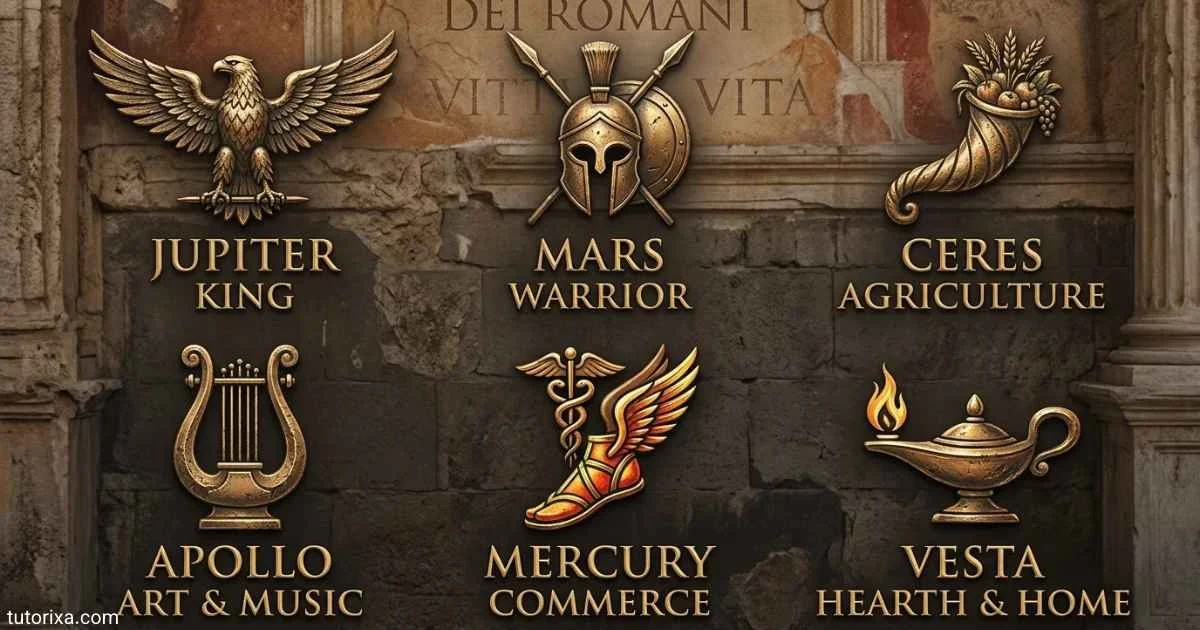
Have you ever wondered what the symbols of ancient Roman gods really mean? From Jupiter’s lightning bolt to Neptune’s trident, these powerful emblems reveal fascinating stories about Roman beliefs, power, and mythology.
I’ll help you discover the hidden meanings behind Roman god symbols and the stories that made them so important. You’ll learn how each symbol connects to a deity’s powers, personality, and role in ancient Roman life.
Whether you’re exploring Roman mythology for school, researching ancient art, or simply following your curiosity, this guide makes everything easy to understand. Let’s explore the most recognizable Roman god symbols and uncover the stories behind them.
Roman God Symbols and Meanings
Roman gods were associated with natural forces, human activities, political power, and different parts of life. Their symbols made these connections easier to recognize. A weapon might represent a god of war, a thunderbolt might identify the ruler of the sky, and a trident might point to the god of the sea.
Here are some of the best-known Roman god symbols and what they represent.
| Roman god | Traditional symbol | Meaning |
| Jupiter | ⚡ Thunderbolt | Sky, storms, authority, and divine power |
| Mars | 🛡️ Shield and spear | War, courage, and military strength |
| Neptune | 🔱 Trident | Sea, water, and earthquakes |
| Mercury | ☿ Caduceus | Messengers, trade, travel, and commerce |
| Venus | ♀ Mirror or hand mirror | Love, beauty, and fertility |
| Saturn | Scythe or sickle | Agriculture, harvest, and the passage of time |
| Pluto | Cerberus or a bident | Underworld and the realm of the dead |
| Apollo | Lyre and laurel | Music, prophecy, healing, and poetry |
| Vulcan | Hammer and anvil | Fire, metalworking, and craftsmanship |
| Minerva | Owl, helmet, and spear | Wisdom, strategy, and skilled crafts |
| Diana | Bow and arrow | Hunting, wilderness, and the moon in later traditions |
| Vesta | Sacred flame | Hearth, home, and family life |
| Ceres | Grain and wheat | Agriculture, crops, and fertility |
| Janus | Two faces | Beginnings, endings, doorways, and transitions |
| Cupid | Bow and arrows | Love and desire |
The symbols in this table are traditional associations, not a set of universally standardized emblems. Some gods have several symbols because their roles changed over time or differed between religious traditions.
A few distinctions are especially useful. The caduceus (☿) is associated with Mercury, while the Rod of Asclepius, a staff with one serpent, is associated with healing. The trident 🔱 is a useful visual reminder of Neptune, but it is a general Unicode emoji rather than a symbol created specifically for Roman mythology.
Roman God Symbols Chart
Use this quick-reference chart to identify important Roman deities, their traditional attributes, and copy-and-paste characters that can complement mythology-themed text.
| God | Symbol to copy | Traditional attribute | Represents |
| Jupiter | ⚡ | Thunderbolt | Authority and the sky |
| Mars | ⚔️ | Sword | War and bravery |
| Neptune | 🔱 | Trident | The sea |
| Mercury | ☿ | Mercury’s planetary sign | The god Mercury and the planet |
| Venus | ♀ | Venus’s planetary sign | Love and beauty |
| Saturn | ♄ | Saturn’s planetary sign | Saturn and its astrological associations |
| Apollo | ☀️ | Sun imagery | Light and artistic inspiration |
| Pluto | ♇ | Pluto’s planetary sign | Pluto and its astronomical associations |
| Vulcan | 🔨 | Hammer | Metalworking and fire |
| Minerva | 🦉 | Owl | Wisdom |
| Diana | 🏹 | Bow and arrow | Hunting |
| Cupid | 💘 | Heart and arrow | Romantic love |
Important: Not every character in this chart is an ancient Roman religious symbol. For example, ♀ and ♄ are astronomical or astrological symbols associated with the names Venus and Saturn, while ⚔️, 🔨, and 🦉 are modern emoji representations of traditional attributes. Their exact appearance depends on the device or platform.
For quick copy-and-paste use, these characters may work well in social media posts, captions, notes, and mythology-themed designs:
- Thunderbolt: ⚡
- Trident: 🔱
- Crossed swords: ⚔️
- Shield: 🛡️
- Hammer: 🔨
- Bow and arrow: 🏹
- Owl: 🦉
- Sun: ☀️
- Female sign: ♀
- Mercury sign: ☿
- Saturn sign: ♄
- Pluto sign: ♇
If you need a historically accurate depiction of a god’s actual attribute, choose an illustration of that object instead of assuming a text character is an authentic ancient emblem.
Roman Gods
Roman religion included many gods and goddesses who were believed to influence different aspects of life. Some were connected to nature, others to family and farming, and others to warfare, commerce, or the state.
Here are some of the most important Roman gods and their roles.
- Jupiter: King of the gods and deity of the sky, thunder, and Roman state authority.
- Juno: Goddess associated with marriage, women, and the protection of the Roman state.
- Neptune: God of the sea and waters, also associated with horses.
- Mars: God of war and an important protector of Rome.
- Venus: Goddess of love, beauty, and fertility, and a legendary ancestral figure in Roman tradition.
- Mercury: Messenger of the gods, associated with trade, travelers, and communication.
- Minerva: Goddess of wisdom, strategic warfare, and skilled crafts.
- Apollo: God associated with prophecy, music, healing, and archery.
- Diana: Goddess of hunting and wilderness.
- Vulcan: God of fire, metalworking, and the forge.
- Saturn: Agricultural deity associated with sowing and harvest.
- Pluto: Ruler of the underworld in Roman mythology.
- Ceres: Goddess of grain and agriculture.
- Vesta: Goddess of the hearth and the sacred fire.
- Janus: God of doorways, transitions, and beginnings.
These gods did not all have the same importance throughout Roman history. Their roles developed as Roman religion changed and absorbed influences from neighboring cultures, particularly the Greeks.
Ancient Roman God Symbols
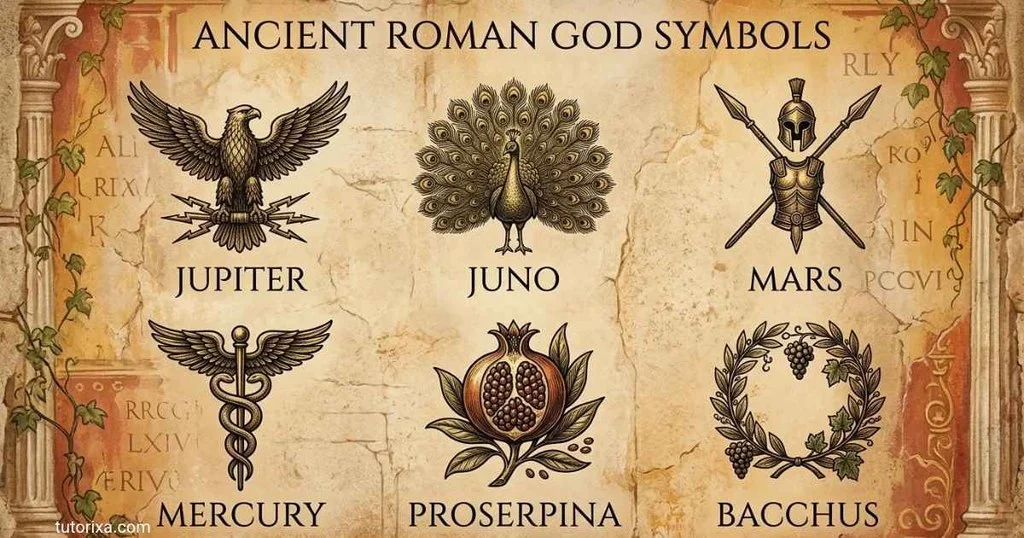
Ancient Roman god symbols were often objects, animals, plants, or features shown in sculpture, coins, paintings, temples, and religious ceremonies. They helped worshippers recognize a deity even when no inscription identified the figure.
The following examples illustrate how traditional attributes were used.
Traditional attributes of Roman deities
Jupiter — Thunderbolt and eagle
The thunderbolt represents his command over the sky and storms. The eagle is associated with sovereignty, strength, and Jupiter’s divine authority.
Mars — Spear, shield, and helmet
Military equipment represents war, discipline, protection, and the defense of Rome.
Neptune — Trident and horse
The trident is a familiar sign of dominion over the sea. Horses also appear in Neptune’s mythology and artistic representations.
Mercury — Caduceus and winged footwear
The staff with two entwined serpents and his winged accessories identify Mercury as a messenger and a patron of travel and commerce.
Vulcan — Hammer, tongs, and anvil
These tools refer to his work as the divine blacksmith, creating metal objects and weapons.
Not every representation follows the same design. An artist might show Mercury with a purse, Jupiter seated on a throne, or Mars wearing armor. Such variations do not necessarily make an image incorrect; they may reflect a particular period, location, or artistic tradition.
Ancient Roman Symbols and Meanings
Roman culture used many symbols beyond images of individual gods. Some expressed military power, some marked religious devotion, and others represented political authority or everyday Roman life.
| Symbol or object | Meaning in Roman culture |
| SPQR | Abbreviation of Senatus Populusque Romanus, meaning “The Senate and People of Rome” |
| Laurel wreath | Victory, honor, and achievement |
| Eagle | Military power and imperial authority, especially in later Roman contexts |
| Fasces | Magistrates’ authority and the power of the Roman state |
| Wolf and twins | The legendary founding story of Rome through Romulus and Remus |
| Cornucopia | Abundance, prosperity, and plenty |
| Olive branch | Peace and reconciliation in broader Mediterranean symbolism |
| Sacred flame | Continuity of the household or state, especially in the worship of Vesta |
| Scepter | Rule, command, and sovereignty |
| Scales | Balance and justice in wider Greco-Roman imagery |
These symbols do not all have the same religious status. SPQR is a civic and political abbreviation, the fasces was an emblem of public authority, and the wolf with Romulus and Remus refers to Rome’s foundation legend.
Meanings can also change over time. For example, the fasces originated as a Roman symbol of authority and was later appropriated by modern political movements. Its historical context matters when interpreting it today.
Greek God Symbols
Greek gods had many of the same attributes as their Roman counterparts because Roman religion adopted and adapted numerous Greek traditions. However, Greek mythology developed its own stories, artistic conventions, and religious practices.
Here are several famous Greek gods and their traditional symbols.
| Greek god | Common symbols | Main association |
| Zeus | ⚡ Thunderbolt, eagle, oak | Sky and kingship |
| Poseidon | 🔱 Trident, horse | Sea and earthquakes |
| Hades | Bident, Cerberus | Underworld |
| Athena | 🦉 Owl, helmet, spear | Wisdom and strategic warfare |
| Ares | Spear, helmet, shield | War |
| Hermes | ☿-like imagery, caduceus, winged sandals | Messages, travel, and commerce |
| Aphrodite | Dove, rose, mirror | Love and beauty |
| Apollo | Lyre, bow, laurel | Music, prophecy, and healing |
| Artemis | Bow, deer, crescent imagery | Hunting and wilderness |
| Hephaestus | Hammer, tongs, anvil | Fire and craftsmanship |
| Cronus | Sickle | Agriculture and the mythic Titan’s story |
The names and attributes of Greek gods can help you identify Roman deities, but some symbols have more than one interpretation. The sickle, for example, is associated with the Titan Cronus in Greek mythology and with Saturn in Roman tradition.
Greek and Roman God Symbols
Greek and Roman mythology overlap, but their gods are not simply identical figures with different names. Roman worship developed in its own cultural and political setting, and the relationship between the traditions became more complex over centuries.
This comparison shows the most familiar counterparts.
| Greek god | Roman counterpart | Shared or related symbols |
| Zeus | Jupiter | Thunderbolt, eagle |
| Hera | Juno | Scepter, diadem, peacock |
| Poseidon | Neptune | Trident, horse |
| Hades | Pluto | Underworld imagery, Cerberus |
| Ares | Mars | Spear, shield, helmet |
| Aphrodite | Venus | Mirror, dove, rose |
| Hermes | Mercury | Caduceus, winged sandals |
| Athena | Minerva | Helmet, spear, owl |
| Apollo | Apollo | Lyre, bow, laurel |
| Artemis | Diana | Bow, deer |
| Hephaestus | Vulcan | Hammer, anvil, tongs |
| Cronus | Saturn | Sickle, agricultural imagery |
Apollo is a particularly interesting case because the Romans adopted his Greek name rather than replacing it with a different Latin name. His worship still developed within Roman religious life.
There are also important differences in emphasis. Mars, for instance, had a central place in Rome’s civic and military identity that went beyond the role usually assigned to Ares in Greek literature. Venus likewise became important in Roman stories about ancestry and state identity.
Use this comparison when researching mythology, choosing a tattoo design, or identifying a figure in classical art. Check the story and historical context instead of relying on a single attribute alone.
Roman Symbolism
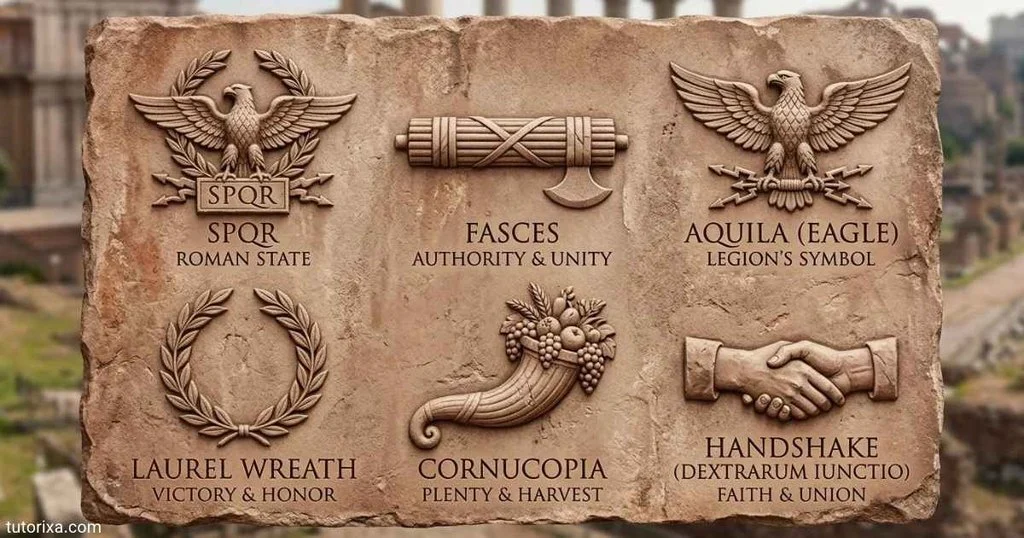
Roman symbolism connected religion, public life, military success, family traditions, and political authority. A symbol could communicate a god’s identity, celebrate a victory, or express the power of Rome itself.
Several themes appear repeatedly in Roman art and religious imagery.
- Power and authority: Jupiter’s thunderbolt, the eagle, and the scepter represent divine or political rule.
- War and protection: Mars’s armor, spear, and shield express military strength and the defense of the community.
- Love and fertility: Venus’s mirror, dove, and related imagery represent beauty, desire, and fertility.
- Nature and agriculture: Saturn’s sickle and Ceres’s grain refer to planting, harvest, and the food supply.
- Travel and communication: Mercury’s caduceus and winged accessories identify him as a messenger and patron of commerce.
- Life and death: Pluto’s underworld associations reflect the Roman understanding of the dead and the world beneath the earth.
- Home and continuity: Vesta’s sacred flame represents the hearth and the preservation of religious and civic life.
Roman symbols also appeared on coins, monuments, military standards, and official buildings. Their meaning depended on where and how they were used. An eagle on a military standard, for example, communicated something different from an eagle appearing in a decorative artwork.
For modern designs, you can use these traditional associations to create a mythology-inspired tattoo, logo, poster, or social media caption. If historical accuracy matters, identify the period and artistic source of the symbol before using it.
Oman Symbols of War
War symbols were central to Roman public life because military success was closely connected with the expansion, security, and political identity of Rome. Mars was the principal Roman god associated with war, but other gods and civic emblems also appeared in military contexts.
The heading provided uses “Oman” rather than “Roman.” The relevant Roman mythology topic is covered below.
| Symbol | Meaning or association |
| ⚔️ Crossed swords | Modern visual shorthand for combat and conflict |
| 🛡️ Shield | Defense, protection, and military readiness |
| 🗡️ Dagger | Close combat; not an exclusive emblem of a particular Roman god |
| 🦅 Eagle | Roman military authority and, especially in the imperial period, the legionary standard |
| 🏹 Bow and arrow | Archery and warfare; also associated with deities such as Apollo and Diana |
| 🪖 Helmet | Modern emoji representation of military equipment |
| Spear | A traditional attribute of Mars and a common weapon in Roman warfare |
| Fasces | Public authority and magistrates’ power, rather than a dedicated symbol of Mars |
The emojis above are convenient for online use, but they are not all ancient Roman symbols. The spear, shield, and eagle have historical connections to Roman military culture, whereas modern emoji designs are contemporary visual substitutes.
For a more historically grounded Roman war design, use Mars with a spear and shield, a Roman military standard, or an eagle associated with a legion. Avoid presenting every sword, helmet, or weapon as an exclusive symbol of a Roman deity.
Mars Roman God Symbols
Mars was the Roman god of war and one of the most important deities in Roman religion. He was associated with military strength, courage, the protection of Rome, and the agricultural traditions that preceded or accompanied his later military prominence.
His symbols usually emphasize weapons, armor, and his identity as a warrior.
| Symbol | Meaning |
| Spear | Military power, combat, and readiness |
| Shield | Protection and defense |
| Helmet | Warrior status and preparation for battle |
| Armor | Strength and military identity |
| Wolf | An animal associated with Mars in Roman tradition |
| Woodpecker | A bird linked with Mars in ancient Roman tradition |
| ♂ | The Mars or male symbol, also used in astronomy and biology |
The male symbol ♂ is particularly useful when searching for a copyable Roman god symbol. Its Unicode character is U+2642, officially named MALE SIGN. It is associated with Mars through the historical use of the planetary symbol for Mars to represent masculinity.
Copy it here: ♂
The character is not a drawing of Mars holding a spear. It is an astronomical and symbolic sign that developed through the association between the planet Mars and the god.
Mars is often compared with the Greek god Ares, but Mars held a special place in Roman state religion and the traditional story of Rome’s origins. His importance went beyond warfare alone.
Jupiter Roman God Symbols
Jupiter was the chief god of the Roman pantheon. He ruled the sky and thunder and represented divine authority, oaths, and the protection of the Roman state.
His best-known symbol is the thunderbolt. The eagle is another major attribute, while the oak tree is also associated with him.
| Symbol | Meaning |
| ⚡ Thunderbolt | Storms, divine power, and authority |
| Eagle | Sovereignty, strength, and divine rule |
| Oak tree | Strength and a traditional sacred association |
| Scepter | Kingship and authority |
| Throne | Supreme status among the gods |
The thunderbolt is the most recognizable modern visual representation of Jupiter. You can copy ⚡ into mythology notes, social media posts, or a design inspired by Roman gods. However, it is a general Unicode emoji rather than a dedicated Jupiter character.
Jupiter’s Greek counterpart is Zeus. Both are associated with thunderbolts and eagles, but their religious roles and cultural significance developed within different traditions.
Pluto Roman God Symbols
Pluto was the Roman god associated with the underworld and the realm of the dead. His name is often used when discussing the hidden wealth of the earth as well as the world beneath it.
Unlike Jupiter’s thunderbolt, Pluto does not have one universally recognized, exclusive symbol. Several traditional objects and figures are associated with his Greek and Roman representations.
| Symbol | Meaning |
| Cerberus | The multiheaded guardian of the underworld |
| Bident | A two-pronged implement associated with underworld imagery |
| Scepter | Rule over the realm of the dead |
| Dark robes | A common artistic way of suggesting the underworld |
| Cornucopia | Wealth and the earth’s hidden abundance in some depictions |
| ♇ | The astronomical Pluto symbol |
The Pluto sign ♇ is a copyable Unicode character, U+2647, officially named PLUTO. It is an astronomical symbol for the dwarf planet and is also used in astrology. It should not be mistaken for a verified ancient Roman religious emblem.
Copy it here: ♇
Pluto corresponds broadly to the Greek Hades. In both traditions, he rules the underworld, but the popular image of a god of death can be misleading. Pluto’s domain concerns the dead and the underworld; he is not simply an embodiment of death itself.
Neptune Roman God Symbols
Neptune was the Roman god of the sea and was also connected with horses and other aspects of water. His Greek counterpart is Poseidon.
The trident is his most recognizable attribute. Its three prongs make it easy to identify in classical sculpture, paintings, and modern mythology-inspired art.
| Symbol | Meaning |
| 🔱 Trident | Rule over the sea and waters |
| Horse | Neptune’s association with horses |
| Sea waves | His connection with the ocean |
| Chariot | Movement across the sea in mythological imagery |
| Fish and marine creatures | The sea and its inhabitants |
The trident emoji 🔱 is useful for copy-and-paste designs, captions, and messages about Roman mythology. It is a general symbol rather than a Unicode character reserved exclusively for Neptune.
For a historical illustration, look for Neptune carrying a trident, sometimes accompanied by horses, sea creatures, or a chariot. A simple trident on its own can also represent Poseidon or other sea-related themes, so the surrounding imagery helps establish the intended identity.
Mercury Roman God Symbols
Mercury was the Roman god of messengers, trade, travel, merchants, and communication. He was associated with movement and exchange, making him an important figure for people who traveled or conducted business.
His most recognizable attribute is the caduceus, a staff with two entwined serpents and, in many depictions, wings.
| Symbol | Meaning |
| Caduceus | Mercury’s role as messenger and herald |
| Winged sandals | Speed and travel |
| Winged helmet | Quick movement and divine messages |
| Purse | Trade, commerce, and wealth |
| Rooster | An animal associated with Mercury in some traditions |
| ☿ | Mercury’s astronomical and astrological symbol |
The character ☿ is Unicode U+263F, officially named MERCURY. It is a convenient copyable sign associated with the planet Mercury and the Roman god.
Copy it here: ☿
The caduceus and ☿ are different symbols. The first is an illustrated staff traditionally carried by Mercury, while the second is a compact planetary sign.
Mercury’s Greek counterpart is Hermes. Both are known for their speed, winged accessories, and association with communication and commerce. For medical designs, be careful not to confuse Mercury’s caduceus with the Rod of Asclepius, a different staff associated with healing.
Apollo Roman God Symbols
Apollo was a major god in both Greek and Roman religion. He was associated with prophecy, music, poetry, healing, and archery. In later Roman traditions, he also became closely linked with solar imagery.
Unlike Mercury or Mars, Apollo retained his Greek name in Roman religion. His symbols reflect his artistic, prophetic, and divine roles.
| Symbol | Meaning |
| Lyre | Music, poetry, and artistic skill |
| Bow and arrows | Archery and divine power |
| Laurel wreath | Victory, poetic achievement, and honor |
| Tripod | Prophecy and the Delphic oracle |
| Sun imagery | Light and Apollo’s later solar associations |
| Python imagery | His mythological connection with Delphi and the defeat of Python |
The sun ☀️ and bow-and-arrow 🏹 emojis are easy to copy, but neither is a unique Unicode emblem of Apollo. A lyre illustration or laurel wreath often communicates his classical associations more precisely.
Apollo is also connected with the Greek and Roman tradition of prophecy. His sanctuary at Delphi was famous for its oracle, making the tripod an important attribute in depictions related to divination.
Saturn Roman God Symbols
Saturn was an ancient Roman deity associated with agriculture, sowing, and harvest. Roman tradition also connected him with a legendary age of prosperity and peace. His festival, Saturnalia, became one of the best-known celebrations in the Roman calendar.
The sickle is among his most familiar attributes, reflecting his agricultural associations. His imagery sometimes overlaps with that of the Greek Titan Cronus, especially in later interpretations.
| Symbol | Meaning |
| Sickle | Harvest, farming, and cutting crops |
| Scythe | Agricultural work and, in later imagery, the passage of time |
| Grain | Fertility and agricultural abundance |
| ♄ | Saturn’s astronomical and astrological symbol |
| Saturnalia imagery | Festivity and the traditional Roman celebration honoring Saturn |
The character ♄ is Unicode U+2644, officially named SATURN. It is a planetary and astrological sign, not a literal drawing of the sickle held by the god.
Copy it here: ♄
Saturn is often compared with Cronus in Greek mythology. The two became closely identified, although Saturn’s Roman religious traditions and the festival of Saturnalia have their own cultural significance.
Vulcan Roman God Symbols
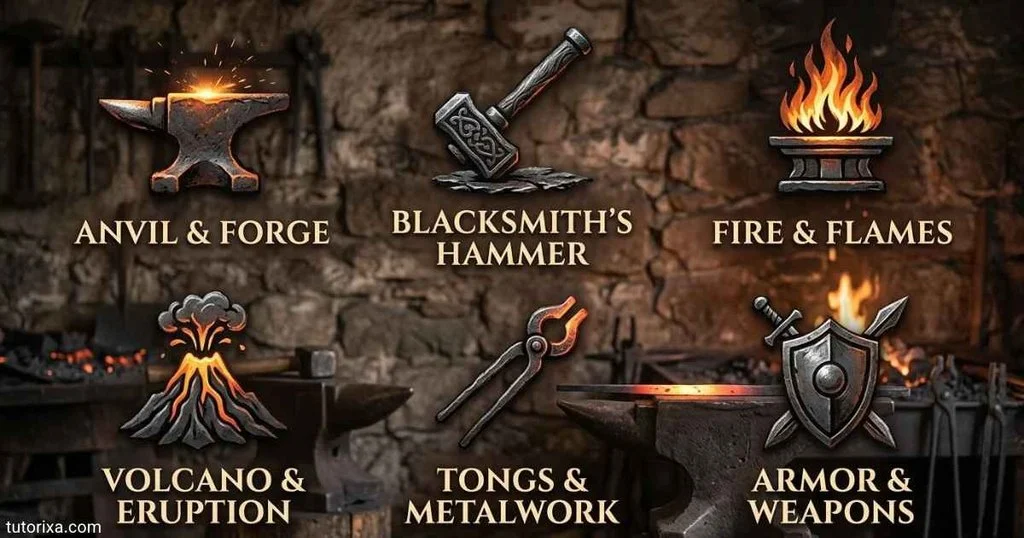
Vulcan was the Roman god of fire, metalworking, and the forge. He was associated with the heat used to shape metal and with the creation of weapons, tools, and other crafted objects.
His symbols come mainly from the blacksmith’s workshop.
| Symbol | Meaning |
| Hammer 🔨 | Shaping metal and skilled work |
| Anvil | Forging tools and weapons |
| Tongs | Handling hot metal |
| Forge | Fire used in metalworking |
| Flames 🔥 | Fire, heat, and the forge |
| Armor and weapons | The products of divine craftsmanship |
The hammer 🔨 and fire 🔥 emojis are useful for quick copy-and-paste content. They represent his traditional associations but are general-purpose emoji, not dedicated Unicode symbols for Vulcan.
Vulcan’s Greek counterpart is Hephaestus. Both are divine craftsmen connected with fire and metalworking. Their stories differ in detail, and Vulcan’s Roman religious role should not be reduced to a simple translation of Greek mythology.
For a mythology-themed design, a hammer and anvil or a figure working at a forge offers a clearer connection to Vulcan than a flame alone.
FAQ
What Is The Most Recognizable Roman God Symbol?
Jupiter’s thunderbolt is one of the most recognizable symbols in Roman mythology. Other familiar examples include Mars’s spear and shield, Neptune’s trident, and Mercury’s caduceus.
Is There A Unicode Symbol For Roman Gods?
There is no single Unicode character set dedicated to Roman gods. However, some related symbols are available, including ☿ for Mercury, ♀ for Venus, ♂ for Mars, ♄ for Saturn, and ♇ for Pluto. General symbols and emojis can represent other traditional attributes.
What Is The Difference Between Greek And Roman God Symbols?
Many Greek and Roman gods share similar symbols because Roman religion adopted and adapted Greek traditions. Zeus and Jupiter, for example, are both associated with thunderbolts and eagles. However, the gods’ stories, religious roles, and cultural importance are not always identical.
Which Roman God Symbol Represents War?
Mars is the principal Roman god associated with war. His traditional attributes include a spear, shield, helmet, and armor. The ♂ character is also associated with Mars through its historical connection with the planet’s symbol.
Can I Copy And Paste Roman God Symbols On Social Media?
Yes. You can copy characters such as ⚡, 🔱, ☿, ♂, ♄, and ♇ into many social media posts, messages, and documents. Emoji appearance may vary across devices, and some symbols may display differently depending on the font or application.
Conclusion
Roman god symbols provide a useful way to explore ancient mythology, from Jupiter’s thunderbolt and Mars’s weapons to Neptune’s trident and Vulcan’s blacksmith tools. Each attribute offers a clue to a deity’s powers, responsibilities, and place in Roman religious life.
The comparison between Greek and Roman gods also shows how mythology changed as cultures influenced one another. Although many deities share familiar attributes, their historical traditions and meanings deserve careful attention.
For quick online use, copyable Unicode characters and emojis can help you create mythology-themed captions, notes, tattoos, and designs. If you need an authentic historical representation, choose an illustration based on classical art or a reliable historical source rather than treating every modern text symbol as an ancient emblem.

I’m Rowan Whitaker, a British writer fascinated by the symbols surrounding us every day. I explore their meanings, origins, cultural significance, and changing interpretations. From ancient marks to modern signs, I enjoy making symbolism easier to understand. My writing helps curious readers discover the hidden messages behind familiar shapes, images, and signs.
Books:
- The Meaning Behind Symbols
- A Modern Guide to Symbolism
 Freddie Beaumont
 Ellis Montgomery