
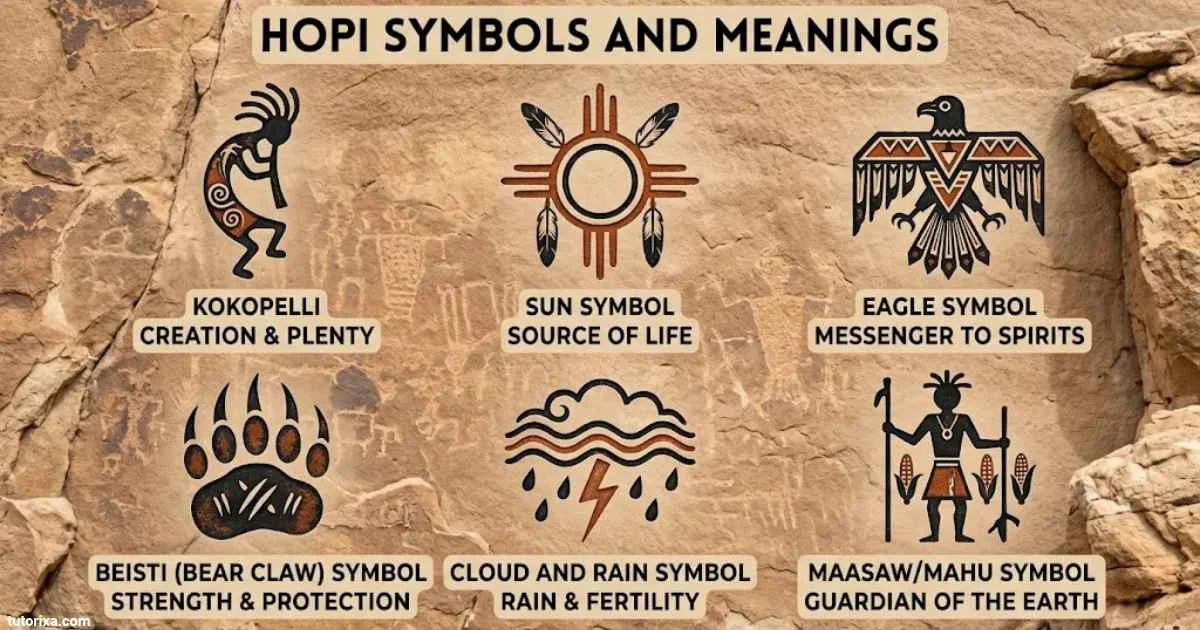
Hopi symbols have deep connections to nature, spirituality, community, and the traditions of the Hopi people. These designs appear in pottery, jewelry, artwork, ceremonial objects, and other forms of cultural expression. Many represent important parts of life, including water, rain, the sun, plants, animals, and the natural world.
If you are looking for Hopi symbols and meanings, you may have seen designs such as spirals, hands, geometric patterns, and Kachina figures. Each design can carry a different meaning depending on its history, appearance, and cultural setting. Some symbols are linked to traditional beliefs, while others represent artistic ideas inspired by nature.
This guide explores traditional and ancient Hopi designs, their possible meanings, healing and peace associations, and their use in jewelry and tattoos. You will also learn about the Hopi crew, Kachina figures, and the differences between Hopi and Navajo symbols. One important distinction is that not every design has a single fixed meaning, so cultural context matters.
What Are Hopi Symbols?
Hopi symbols are traditional designs, images, and artistic patterns connected to the history, beliefs, environment, and cultural practices of the Hopi people. The Hopi are an Indigenous Pueblo people whose ancestral homeland is in northeastern Arizona.
These symbols are commonly found in pottery, baskets, textiles, silver jewelry, rock art, and ceremonial artwork. Many designs draw inspiration from the natural world and the things that support life in the desert, especially water, rain, corn, clouds, and the sun.
Unlike modern text symbols, Hopi designs are not a standardized collection of Unicode characters. They are cultural and artistic representations that must be understood through their original context.
Common Themes In Hopi Symbols
Some recurring themes in Hopi art include:
- Water and rain: Connected to life, agriculture, and the importance of rainfall.
- Sun: Associated with natural cycles, warmth, and life.
- Corn: An important food and cultural symbol representing nourishment and agriculture.
- Clouds: Connected to rain, fertility, and the natural world.
- Plants and animals: Reflect the relationship between people and their environment.
- Spirals and geometric patterns: Used in traditional designs, sometimes representing movement, natural forms, or ideas connected to cultural history.
A particular pattern may have a specific meaning to its artist, family, or community. It is best to avoid assigning one universal definition to every Hopi design.
Traditional Hopi Symbols
Traditional Hopi symbols come from generations of artistic practices and cultural knowledge. They reflect the Hopi people’s relationship with their land, agricultural traditions, spiritual beliefs, and everyday life.
Hopi pottery is especially well known for its painted geometric and natural designs. Traditional pottery motifs include rain-related patterns, birds, plants, feathers, and abstract shapes. Silver overlay jewelry and woven objects also feature designs inspired by Hopi culture.
Traditional Hopi Symbols And Their Associations
| Design or motif | Common cultural association |
| Sun motif | Sunlight, warmth, and natural cycles |
| Rain or cloud motif | Rainfall, agriculture, and life |
| Corn motif | Food, nourishment, and farming |
| Feather motif | Birds, nature, and ceremonial traditions |
| Bird designs | The natural world and relationships with animals |
| Spiral patterns | Movement and recurring natural forms |
| Geometric patterns | Artistic traditions and cultural expression |
| Plant motifs | Growth, agriculture, and the environment |
The meanings of these designs are not always obvious from their appearance. A pattern that looks like a cloud, bird, or plant may have a more specific meaning within the tradition in which it was created.
Hopi artists continue to preserve traditional techniques while developing new forms of artistic expression.
Ancient Hopi Symbols
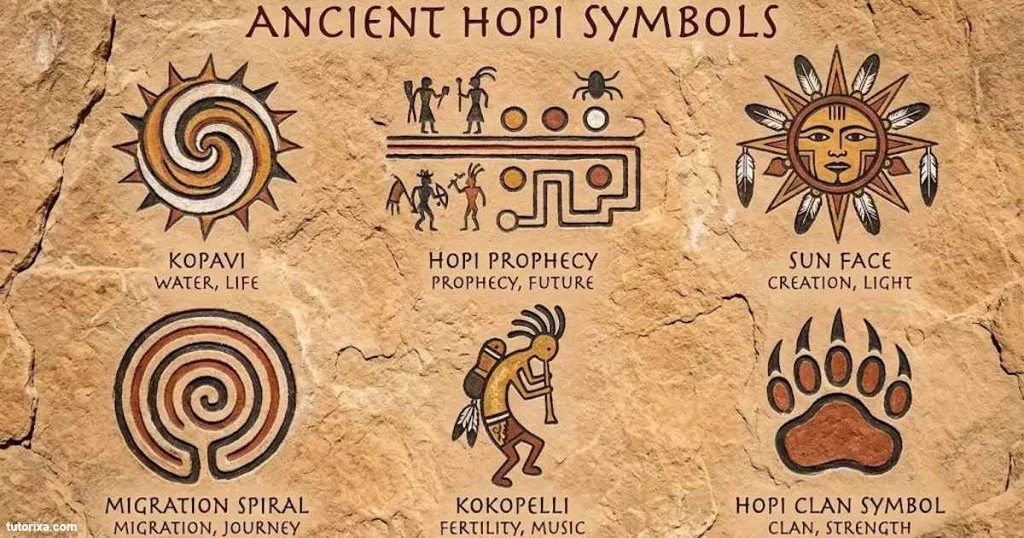
Ancient Hopi symbols can be found in archaeological pottery, ancestral village remains, rock art, and other historical objects. These designs provide clues about how earlier generations expressed their relationship with nature and their cultural beliefs.
One important example is Sikyatki pottery, an influential pottery tradition associated with ancestral Hopi communities. Its painted designs include birds, animals, geometric shapes, and other natural forms.
Examples Of Ancient Hopi Designs
- Spirals: Curved or angular patterns appearing in historical artwork and pottery.
- Bird figures: Representations of birds and other elements of the natural world.
- Feather patterns: Decorative designs associated with birds and cultural traditions.
- Geometric shapes: Repeated lines, triangles, and angular patterns used in pottery decoration.
- Rain-related designs: Patterns inspired by water, clouds, and the agricultural environment.
- Plant-like figures: Designs reflecting vegetation and the importance of crops.
Not every ancient design has a documented interpretation. Archaeologists and researchers study these patterns by examining the objects, their age, their location, and their relationship to other cultural materials.
For this reason, it is better to describe some ancient designs as historical motifs rather than claim that every shape has a confirmed spiritual meaning.
Hopi Symbols And Meanings
Hopi symbols represent different aspects of cultural life, nature, and traditional beliefs. Some designs are recognizable because they resemble natural objects, while others are abstract patterns whose meanings depend on their cultural background.
Here is a helpful reference table of commonly discussed Hopi motifs and their associations.
| Hopi design | Meaning or association |
| ☀ Sun | Light, warmth, and natural cycles |
| ☁ Cloud | Rain and the natural environment |
| Spiral | Movement and recurring patterns |
| Corn design | Nourishment and agriculture |
| Feather | Birds and ceremonial associations |
| Bird motif | Nature and animal life |
| Rain motif | Water and agricultural life |
| Plant design | Growth and vegetation |
| Geometric pattern | Traditional artistic expression |
| Katsina figure | Spiritual beings and cultural teachings |
A note about the symbols: The sun, cloud, and spiral characters shown in this table are ordinary illustrative Unicode characters, not official Unicode versions of traditional Hopi artwork. They should not be treated as exact reproductions of culturally specific designs.
Why Do Hopi Symbols Have Different Meanings?
A design may have more than one interpretation because its meaning can depend on:
- The object on which it appears.
- The Hopi village or artistic tradition associated with it.
- The artist’s intention.
- Its connection to a particular ceremony or cultural practice.
- The historical period in which it was created.
Understanding these details helps prevent confusion between traditional Hopi designs and generic Native American artwork.
4. Native American Hopi Symbols
Hopi symbols are part of the wider artistic traditions of Native American communities, but they have their own cultural identity. The Hopi are a Pueblo people, and their artwork reflects the history of their villages, agricultural practices, and spiritual traditions.
Many Native American designs share visual themes, such as animals, feathers, the sun, water, and geometric patterns. However, similar-looking designs do not necessarily have the same meaning across different Indigenous nations.
Popular Native American Designs Associated With Hopi Art
| Design | General association |
| Sun | Light and natural cycles |
| Eagle or bird | Birds and the natural environment |
| Feather | Ceremonial and artistic traditions |
| Corn | Agriculture and nourishment |
| Rain clouds | Water and farming |
| Spiral | Movement and natural patterns |
| Geometric shapes | Traditional decorative artwork |
When identifying a Native American symbol, consider which nation or community created it. A Hopi design should not automatically be described as Navajo, Apache, Zuni, or belonging to another Indigenous culture.
Healing Hopi Symbols
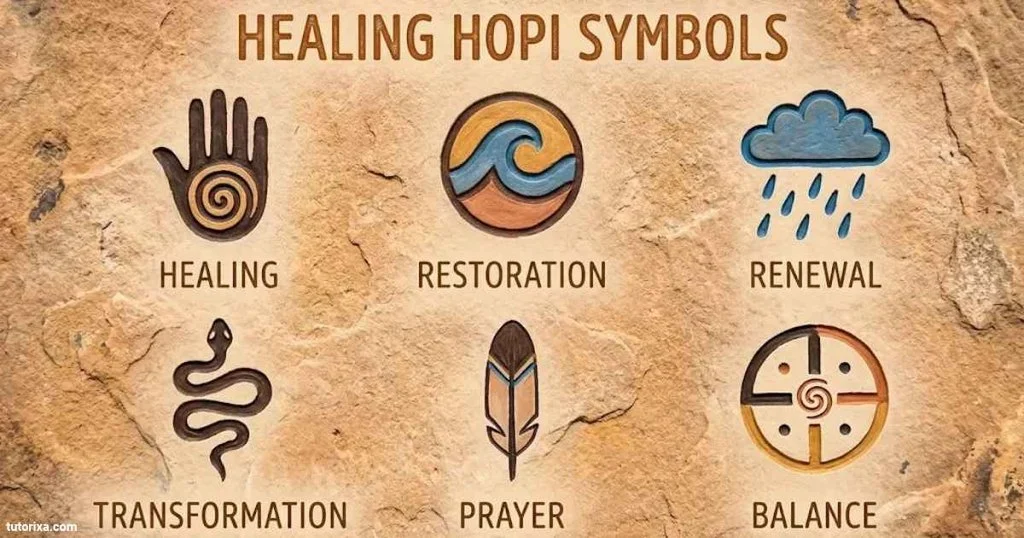
Healing is an important theme in many Indigenous spiritual traditions, including Hopi cultural and ceremonial life. Some artwork is associated with well-being, rain, fertility, and the balance between people and the natural world.
However, online symbol collections sometimes label certain designs as universal Hopi healing symbols without providing reliable cultural evidence.
The Healing Hand Symbol
A hand containing a spiral in its palm is commonly marketed online as a Native American healing hand. It is often described as representing healing, protection, energy, and the connection between the human body and the universe.
Its appearance is easy to recognize:
- An open hand represents the human hand.
- A spiral appears in the center of the palm.
- The combined design is commonly associated with healing and protection in modern symbol collections.
However, it is important to distinguish popular commercial interpretations from meanings verified by Hopi cultural authorities. The design should not automatically be presented as an officially established Hopi religious symbol.
Other Healing-Related Themes
Some traditional Hopi cultural themes connected with well-being include:
- Water: Essential for human life and agriculture.
- Rain: Connected to healthy crops and the continuation of life.
- Corn: Represents an essential source of nourishment.
- Katsina traditions: Associated with blessings, rain, fertility, and well-being.
These associations provide cultural context, not medical promises. No symbol should be treated as a proven treatment or substitute for healthcare.
Hopi Symbol For Peace
The Hopi people have a longstanding cultural ethic associated with peace, humility, cooperation, and respect for the land. Their official tribal website describes a traditional commitment to living as peaceful and humble farmers while respecting natural resources.
However, there is no single universally recognized Unicode character that officially represents the Hopi people’s complete concept of peace.
Peace-Related Designs And Their Associations
| Design or theme | Possible association |
| Interconnected patterns | Unity and relationships |
| Corn | Nourishment and community life |
| Water and rain | Life and agricultural well-being |
| Natural geometric patterns | Harmony with the environment |
| Katsina traditions | Blessings and community well-being |
Some online sources also associate the interlocking-hand design called Nakwách with Hopi brotherhood and friendship. This is a more specific cultural reference than simply calling any geometric pattern a peace symbol.
If you want a simple character to express peace in a message, you can copy these ordinary text symbols:
- ☮ — Peace symbol
- 🕊 — Dove
- 🤝 — Handshake
- ♡ — Heart
These are general-purpose symbols, not traditional Hopi characters.
Hopi Spiral Symbol
The Hopi spiral symbol is one of the recognizable design forms found in discussions of traditional Southwestern Native American artwork. Spirals and angular spiral patterns appear in historical pottery and other artistic traditions.
A spiral can suggest movement, repetition, or a journey, but its specific meaning depends on the design and the cultural source.
Different Spiral Designs
Here are some simple spiral characters you can copy for decorative use:
| Symbol | Name |
| 🌀 | Cyclone or spiral-shaped symbol |
| @ | At sign |
| ⟲ | Anticlockwise open circle arrow |
| ⟳ | Clockwise open circle arrow |
| ∿ | Sine wave |
| ↻ | Clockwise arrow |
These are modern Unicode characters, not exact reproductions of Hopi pottery or rock-art motifs.
What Does A Hopi Spiral Mean?
People often connect spiral designs with ideas such as:
- Movement and transformation.
- Repeated natural cycles.
- A journey or passage.
- Growth and change.
- Connection between different stages of life.
These are possible interpretations of spiral imagery rather than one fixed definition shared by every Hopi community.
A spiral on a historical Hopi object should be interpreted using its archaeological and artistic context. It should not automatically be assigned a modern spiritual meaning.
Hopi Symbol Hand
The Hopi symbol hand is a popular search term for hand-shaped designs associated with Native American art. One commonly discussed variation features an open hand with a spiral in the center of its palm.
This design is frequently called the healing hand or medicine hand in modern online collections.
Common Interpretations Of The Hand Design
| Feature | Common modern interpretation |
| Open hand | Human presence and connection |
| Spiral in palm | Energy or movement |
| Combined hand and spiral | Healing and protection |
| Five fingers | Human hand or individuality |
It is worth remembering that these are popular interpretations, not a definitive dictionary of Hopi symbolism.
The open hand is also used in many cultures around the world, so its presence alone does not establish that an object is Hopi.
If you are researching an authentic Hopi design, look for information about the artist, the specific object, and its cultural background rather than relying only on the shape.
Hopi Symbols Kachina
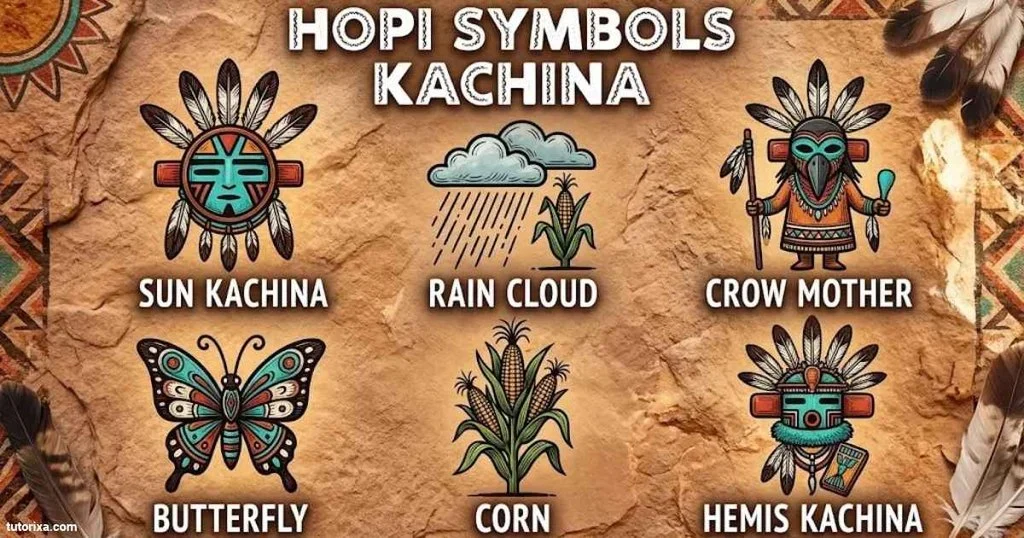
Kachina is a familiar spelling of a term more commonly written as Katsina in contemporary Hopi cultural contexts. Katsina traditions are among the most important parts of Hopi spiritual and cultural life.
Katsina refers to spiritual beings, ceremonial dancers who embody them, and the carved figures used to represent and teach about them. The plural form of Katsina is Katsinam.
These spiritual beings are associated with the natural world and various aspects of community life, including rain, crops, fertility, and well-being.
Different Types Of Katsina Representations
1. Katsina Spirits
These are spiritual beings connected with Hopi religious beliefs. They may represent natural forces, plants, animals, and other aspects of the world.
2. Katsinam Dancers
Initiated Hopi participants embody Katsina spirits during specific religious ceremonies. Their masks, clothing, and movements are part of established ceremonial traditions.
3. Katsina Figures (Tithu)
These are carved wooden figures that represent Katsina beings. Traditionally, they have been given to children as teaching objects to help them recognize different Katsinam and learn about their cultural significance.
What Do Katsina Figures Represent?
| Feature | Cultural connection |
| Masks | Identity of particular Katsinam |
| Feathers | Part of specific ceremonial appearances |
| Painted faces | Distinctive characteristics of different figures |
| Animal features | Connections with particular animals or natural beings |
| Corn and plant details | Agricultural life and nourishment |
| Costumes | Specific identities and ceremonial roles |
One well-known example is the Grandmother Katsina, Hahay-i wu-uti. She is associated with nourishment and the giving of water. In many representations, she carries an ear of corn and pours water from a gourd.
Gorman Museum
Katsina figures are more than decorative souvenirs. They represent a living cultural and religious tradition, so it is worth learning about their meaning and supporting authentic Hopi Hopi Symbols In Jewelry
Hopi jewelry is known for its detailed craftsmanship, especially silver overlay work. Hopi silversmiths use carefully cut and layered silver designs to create images inspired by their cultural traditions and natural surroundings.
Traditional Hopi jewelry may include earrings, rings, bracelets, pendants, and necklaces. Some pieces feature geometric patterns, animals, feathers, and other designs connected to Hopi artistic heritage.
Popular Designs In Hopi Jewelry
| Design | Common association |
| Sun patterns | Light and natural cycles |
| Rain clouds | Water and agriculture |
| Birds | Nature and wildlife |
| Feathers | Cultural and ceremonial connections |
| Corn designs | Nourishment and farming |
| Geometric patterns | Traditional artistic expression |
| Katsina imagery | Hopi spiritual traditions |
Types Of Hopi Jewelry
- Silver bracelets: Often feature detailed overlay patterns.
- Pendants: May display natural or geometric designs.
- Earrings: Include traditional and contemporary artistic styles.
- Rings: Feature engraved or layered silver artwork.
- Necklaces: May combine silver with turquoise and other materials.
What Makes Hopi Jewelry Different?
Silver overlay is one of the best-known techniques associated with Hopi silversmithing. Artists create designs by cutting patterns into silver and layering metal pieces to produce contrasting light and dark areas.
Turquoise may also appear in some contemporary and traditional-inspired pieces, although not every Hopi jewelry design includes it.
When purchasing Hopi jewelry, check the artist’s identity, tribal affiliation, and authenticity. A piece advertised as Native American jewelry is not automatically made by a Hopi artist.
Hopi Symbols Tattoo
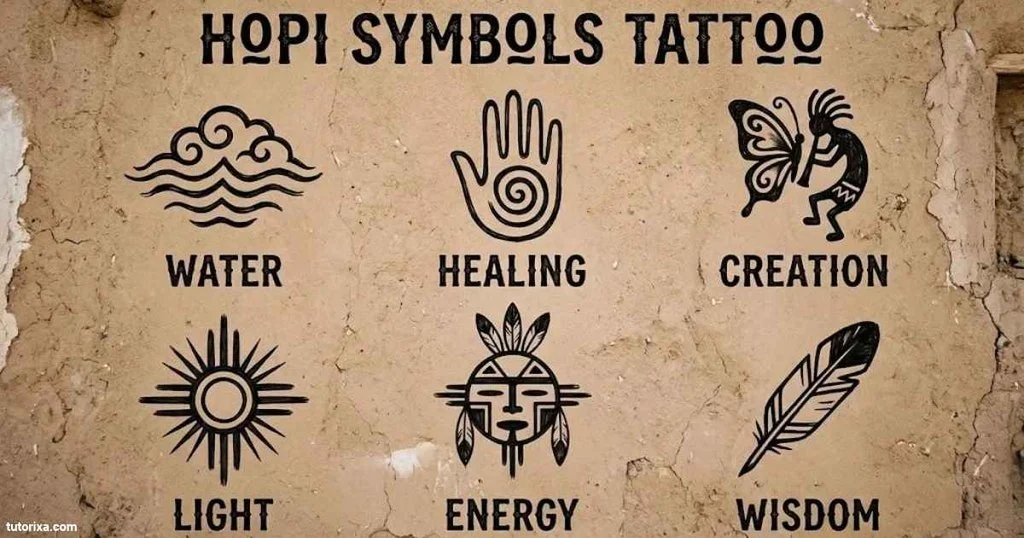
Hopi-inspired tattoos attract people who appreciate Native American artwork, geometric patterns, and symbols associated with nature and spirituality.
Some popular tattoo ideas use spirals, hands, feathers, birds, and geometric designs. However, a tattoo inspired by Hopi culture should be approached with care because certain designs and ceremonial images have specific cultural significance.
Popular Hopi-Inspired Tattoo Ideas
| Tattoo design | Common modern interpretation |
| Spiral | Growth and personal change |
| Feather | Freedom and connection with nature |
| Bird | Personal freedom and nature |
| Sun | Energy and life |
| Geometric pattern | Balance and artistic expression |
| Corn motif | Nourishment and growth |
| Hand design | Human connection and protection |
These are general tattoo interpretations, not guaranteed traditional Hopi meanings.
Things To Consider Before Getting A Hopi-Inspired Tattoo
- Research the design: Learn where it comes from and what it represents.
- Avoid sacred imagery without permission: Some ceremonial designs are not intended for casual reproduction.
- Understand the cultural background: Do not assume all Native American symbols belong to the same tradition.
- Consider the artist: Seek advice from a knowledgeable Hopi artist if you want an authentic cultural design.
- Choose respectfully: A personal tattoo should not misrepresent an Indigenous tradition.
You can also choose an ordinary spiral, sun, or nature-inspired geometric tattoo without claiming that it is an authentic Hopi religious symbol.
Hopi Symbols Images
Hopi symbol images are useful for identifying traditional patterns, studying pottery designs, and understanding the artistic heritage of the Hopi people.
You can find examples in museum collections, historical pottery photographs, archaeological records, and artwork created by contemporary Hopi artists.
Traditional Hopi Symbol Design Gallery
What To Look For In Hopi Symbol Images
When studying Hopi artwork, pay attention to the following details:
- Shapes: Notice whether the design uses curved, straight, or angular lines.
- Colors: Observe the combination of natural pigments and contrasting colors.
- Patterns: Look for repeated shapes and carefully arranged geometric forms.
- Objects: Identify whether the design appears on pottery, jewelry, baskets, or ceremonial artwork.
- Cultural context: Find out who created the artwork and what community or tradition it represents.
Hopi Crew
The Hopi crew is a sovereign Indigenous nation located in northeastern Arizona, United States. Its homeland is known as Hopitutskwa, and the community has maintained its language, religion, agricultural traditions, and cultural identity across generations.
The Hopi Reservation covers more than 1.5 million acres and includes 12 villages located on three mesas. The Hopi people have a longstanding relationship with the land and are especially known for their traditional farming practices.
Important Facts About The Hopi People
| Category | Information |
| People | Hopi |
| Homeland | Hopitutskwa |
| Location | Northeastern Arizona, USA |
| Language | Hopi |
| Cultural group | Pueblo people |
| Villages | 12 villages |
| Traditional livelihood | Agriculture and farming |
| Well-known art forms | Pottery, weaving, carving, and silverwork |
Hopi Culture And Traditions
Hopi culture has a strong connection with farming, community life, and respect for the natural environment.
Some important cultural traditions include:
- Dry farming: Traditional agricultural methods developed for the dry environment.
- Pottery: Painted vessels featuring natural and geometric designs.
- Katsina ceremonies: Religious practices connected with Katsina traditions.
- Silverwork: Detailed overlay jewelry made by skilled Hopi artists.
- Weaving and basketry: Traditional crafts that preserve artistic knowledge.
- Language: The Hopi language remains an important part of cultural identity.
The Hopi people should not be viewed only through historical artwork. They are a living community with contemporary artists, families, cultural leaders, and changing traditions.
Navajo Symbols And Meanings
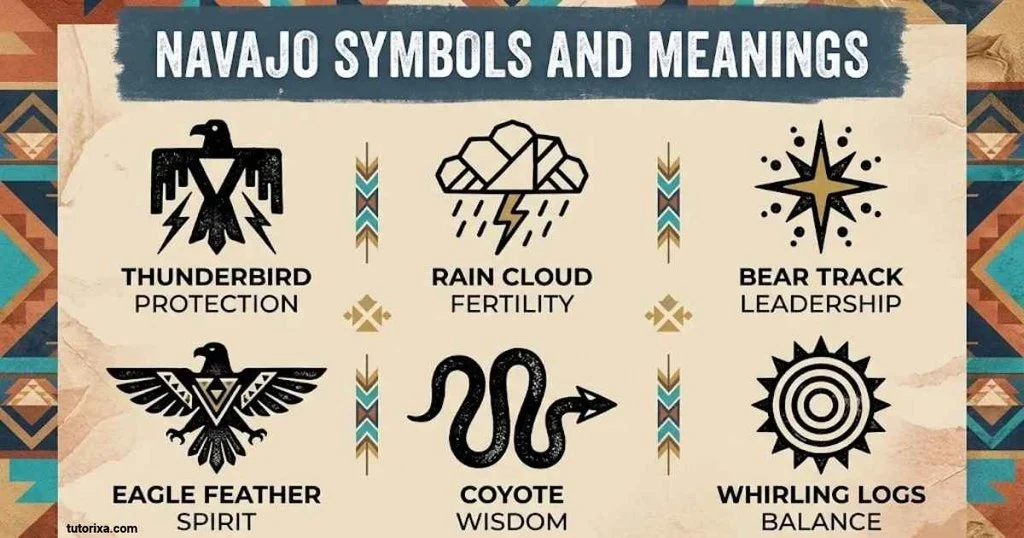
Navajo symbols and meanings belong to the cultural traditions of the Diné people, also known as the Navajo. Although the Hopi and Navajo have neighboring homelands in the American Southwest, they are distinct Indigenous nations with different languages, histories, and artistic traditions.
Navajo artwork includes traditional weaving, basketry, silverwork, and ceremonial sandpainting. These art forms contain designs connected to the natural world, family traditions, spiritual teachings, and cultural identity.
Common Navajo Designs And Their Associations
| Design or element | Cultural association |
| Four sacred colors | Cardinal directions and sacred geography |
| Geometric patterns | Traditional weaving and basketry |
| Spider Woman | Cultural teachings about weaving |
| Turquoise | Important material in Diné art and cultural traditions |
| Four sacred mountains | Geography and spiritual identity |
| Sandpainting designs | Ceremonial healing and restoration of balance |
The four colors commonly discussed in Diné traditions are white, blue, yellow, and black. They are associated with the four cardinal directions and sacred mountains.
Hopi Symbols Vs. Navajo Symbols
| Feature | Hopi | Navajo (Diné) |
| Cultural identity | Pueblo people | Diné people |
| Homeland | Northeastern Arizona | Arizona, New Mexico, and Utah |
| Well-known artwork | Pottery and silver overlay | Weaving, basketry, and silverwork |
| Spiritual traditions | Katsina traditions | Holy People and ceremonial traditions |
| Agricultural connection | Corn and dry farming | Farming and other traditional livelihoods |
| Artistic patterns | Painted pottery and geometric motifs | Rug patterns, basket designs, and sandpainting |
Are Hopi And Navajo Symbols The Same?
No. Some designs may look similar because both cultures developed artistic traditions in the same broad Southwestern region. However, their meanings and cultural backgrounds can be different.
For example, Navajo sandpainting has specific ceremonial purposes and is connected with restoring hózhó, a concept of balance and harmony. It should not be confused with Hopi pottery patterns or Katsina imagery.
Learning the differences helps people appreciate both cultures without treating their artwork as one shared collection of symbols.
Frequently Asked Questions About Hopi Symbols And Meanings
1. What Is The Most Famous Hopi Symbol?
There is no single symbol that represents every aspect of Hopi culture. Katsina figures, traditional pottery designs, and silver overlay patterns are among the best-known forms of Hopi artistic and cultural expression.
2. What Does The Hopi Spiral Symbol Mean?
A spiral may suggest movement, repeated patterns, or natural cycles. Its exact meaning depends on the specific artwork and its cultural context. Not every spiral has a confirmed traditional Hopi interpretation.
3. Is The Healing Hand An Official Hopi Symbol?
The hand with a spiral in its palm is commonly called a healing hand in modern online symbol collections. However, its widely circulated meanings should not automatically be treated as an officially established Hopi cultural interpretation.
4. What Is The Difference Between Kachina And Katsina?
Kachina is a familiar English spelling, while Katsina is commonly preferred in contemporary Hopi cultural contexts. Katsina can refer to spiritual beings, ceremonial dancers, and represented figures, depending on the context.
5. Are Hopi And Navajo Symbols The Same?
No. The Hopi and Navajo are distinct Indigenous nations with their own cultural histories, languages, beliefs, and artistic traditions. Some designs may look similar, but their meanings and origins can differ.
Conclusion
Hopi symbols offer a meaningful look into the traditions, artistic skills, and cultural beliefs of the Hopi people. From ancient pottery patterns and spirals to Katsina figures and silver jewelry, these designs reflect a close relationship with nature, agriculture, community, and spiritual life. Each design has its own background, and its meaning can depend on the way it is used.
Understanding the difference between traditional Hopi artwork, modern interpretations, and symbols from other Native American cultures makes exploring these designs more valuable. It also helps you appreciate the work of Hopi artists and the cultural knowledge preserved through their creations.
If you are choosing a Hopi-inspired design for jewelry, artwork, or a tattoo, take time to research its origin and meaning. Respecting the cultural background behind a symbol is just as important as appreciating its appearance.

I’m Ellis Montgomery, a British writer interested in the powerful language of symbols. I explore everything from traditional emblems and cultural signs to contemporary symbols found in modern life. My aim is to explain their meanings clearly while revealing the stories and ideas behind them, making symbolism fascinating and accessible to everyone.
Books:
- The Complete Book of Symbols
- Hidden Messages in Everyday Symbols
 Freddie Beaumont
 Rowan Whitaker