
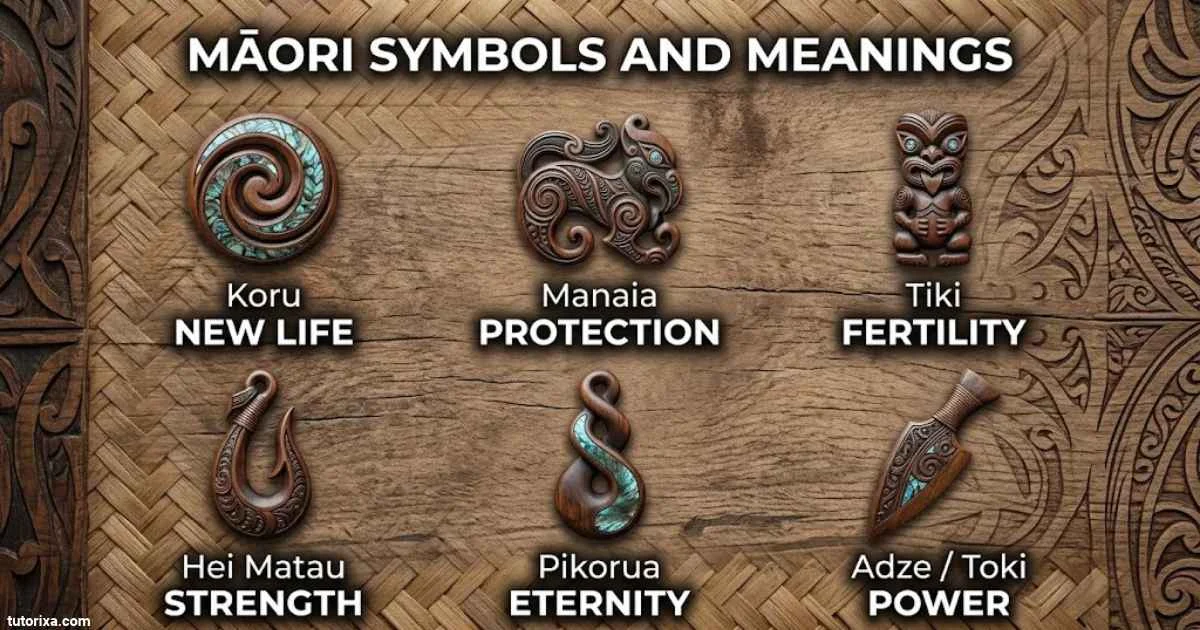
Māori symbols are an important part of the culture, history, and identity of the Māori people of Aotearoa (New Zealand). These traditional designs often represent ideas such as new beginnings, love, family connections, strength, protection, and the journey of life. Many are inspired by nature, ancestral stories, and the relationship between people and the world around them.
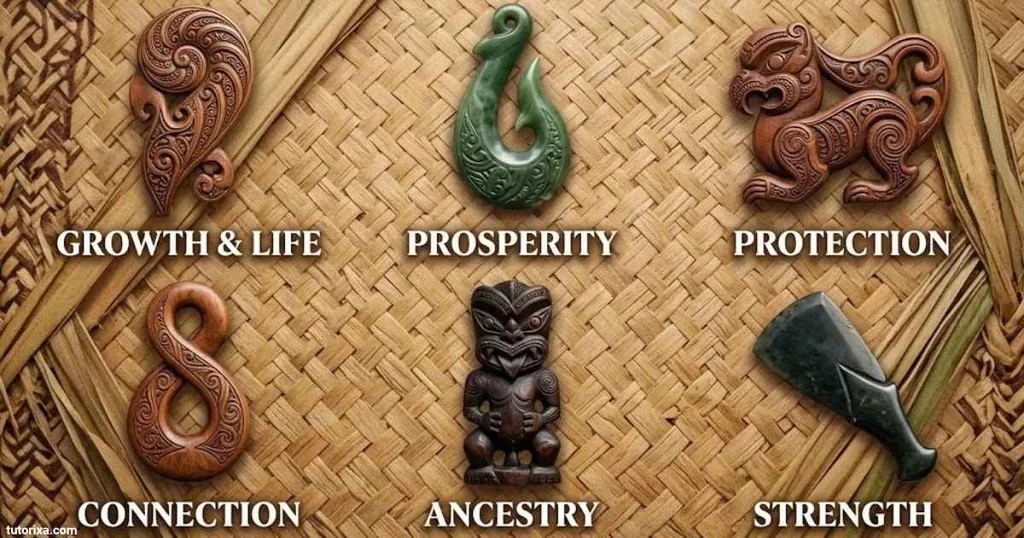
Some of the best-known Māori designs include the koru, pikorua, manaia, hei matau, and toki. Each has its own visual form and cultural associations. These designs appear in traditional carving, weaving, artwork, jewellery, and tā moko (Māori tattooing). Their meanings can also vary depending on the artist, community, and context in which they appear.
If you are looking for Māori symbols and meanings for personal understanding, artwork, or tattoo inspiration, this guide explores their history and significance. You will discover symbols connected with love, family, and strength, learn about traditional Māori tattoo designs for such as people, and find helpful guidance for drawing Māori-inspired patterns respectfully.
Māori Symbols And Meanings
Māori symbols are traditional visual designs that communicate stories, relationships, values, and cultural knowledge. They are found in whakairo (carving), raranga (weaving), kōwhaiwhai (painted rafter patterns), and tā moko.
Unlike ordinary decorative shapes, many traditional Māori designs carry connections to whakapapa (genealogy), identity, nature, and spiritual beliefs. Their meanings are not always fixed. A design can have different interpretations depending on its cultural background and the person who created or wears it.
Here are some well-known Māori symbols and their commonly recognised meanings.
| Māori Symbol | Common Meaning |
| Koru | New beginnings, growth, harmony, and renewal |
| Pikorua | Connection, relationships, and joining of paths |
| Manaia | Spiritual guardianship and protection |
| Hei matau | Strength, determination, abundance, and safe journeys |
| Toki | Strength, control, and determination |
| Roimata | Tears, grief, comfort, and consolation |
| Hei tiki | A traditional carved human figure with complex cultural associations |
A closer look at popular Māori symbols:
- Koru: Inspired by the unfurling fern frond, its spiral shape represents growth, renewal, and the continuing journey of life.
- Pikorua: Often called the twist, it represents the joining of two people or spirits and the paths they share.
- Manaia: A guardian figure associated with spiritual guidance and protection.
- Hei matau: A traditional fishhook design connected with abundance, strength, and safe travel over water.
- Toki: Inspired by an adze, this design represents determination, strength, and control.
- Roimata: Its teardrop shape is associated with sadness, grief, and comfort.
- Hei tiki: A carved human figure traditionally made from materials such as pounamu (New Zealand greenstone). Its significance has different interpretations.
These meanings are useful starting points, but they should not be treated as universal definitions. Māori art is connected to living cultural traditions, and the knowledge behind particular designs belongs within their cultural context.
Ancient Māori Symbols And Meanings
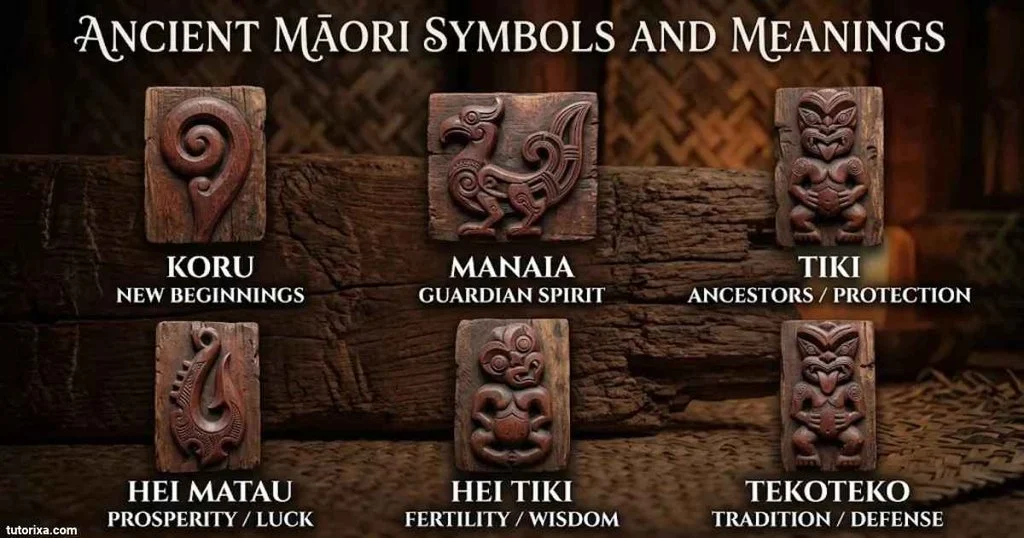
Ancient Māori symbols developed through generations of artistic and cultural practices. Before written records became common, Māori communities passed knowledge, histories, and stories through oral traditions and visual art.
Traditional designs appeared on meeting houses, canoes, weapons, jewellery, clothing, and other important objects. These patterns could communicate ancestral connections, community identity, achievements, and spiritual ideas.
Here are several traditional designs and their commonly discussed associations.
1. Koru – Creation And New Beginnings
The koru is inspired by the new growth of a silver fern. Its circular shape suggests continuous movement, while its inward coil can represent returning to one’s origin.
It is commonly associated with:
- New beginnings and fresh starts.
- Personal growth and development.
- Harmony and balance.
- The continuing cycle of life.
2. Pikorua – Connection And Relationships
The pikorua features two intertwined forms. It is commonly understood as a representation of two people or spirits coming together.
Its associations include friendship, connection, shared journeys, and lasting relationships.
3. Manaia – Spiritual Guardian
The manaia is a distinctive guardian figure. Its traditional form is often described as combining bird-like, human, and fish-like features.
It is associated with spiritual guidance, guardianship, and protection.
4. Hei Matau – Strength And Abundance
The hei matau represents a fishhook. It has connections with the ocean, abundance, determination, and safe journeys, particularly journeys over water.
5. Toki – Courage And Determination
The toki takes its shape from a traditional adze. It is commonly associated with strength, control, determination, and the ability to overcome challenges.
6. Roimata – Tears And Healing
Roimata means teardrop. It is connected with grief, sadness, and emotional comfort. Historically, a roimata could be given as a gift to console someone experiencing loss.
These traditional symbols demonstrate how Māori art can communicate ideas through simple but meaningful shapes.
Intellectual Property Office of New Zealand+2
Māori Symbols And Meanings Koru
The koru is one of the most recognisable Māori designs. It takes inspiration from the unfurling frond of the silver fern, a plant closely associated with New Zealand.
Its curved spiral shape represents the movement of life, while its new growth suggests the beginning of something meaningful. The design is often used to express hope, development, and positive change.
Common Meanings Of The Koru Symbol
| Meaning | Explanation |
| New beginnings | Starting a new chapter in life |
| Growth | Learning and personal development |
| Renewal | Recovering and beginning again |
| Harmony | Living with balance and connection |
| Life | The continuing journey of existence |
| Family | Growth and the continuation of generations |
| Hope | Looking forward to positive changes |
Different Koru Design Variations
- Single koru: A simple spiral associated with growth and new beginnings.
- Double koru: Two connected spiral forms that can suggest relationships and shared development.
- Triple koru: Multiple spirals that may represent interconnected people, growth, or different life journeys.
- Multiple koru: Repeated spirals used to create larger decorative patterns.
These are descriptive design variations rather than universal traditional definitions.
Why Is The Koru Popular?
The koru is popular because its natural shape communicates a positive message without needing words. People often associate it with personal development, new opportunities, and important life changes.
It also appears in contemporary jewellery, paintings, home decorations, and graphic designs.
However, the koru is more than an attractive spiral. It comes from a meaningful Māori visual tradition, so its cultural origins deserve recognition.
Māori Symbol For Love
Love is an important part of Māori culture and is closely connected with aroha, a concept that includes love, affection, compassion, empathy, and care.
There is no single universally accepted Māori symbol that represents every form of love. However, some traditional designs are commonly associated with relationships, connection, and lasting bonds.
1. Pikorua – Love And Togetherness
The pikorua is one of the most suitable traditional designs for expressing a loving connection.
Its intertwined shape is commonly associated with two people whose lives and journeys are connected. It can represent:
- Romantic relationships.
- Deep friendship.
- Loyalty and commitment.
- Two people sharing life’s journey.
- Lasting emotional connections.
2. Koru – Growing Love
The koru is associated with growth and new beginnings. In a personal design, it can express the idea of love that develops over time.
It may be used to represent a growing relationship, a new chapter in love, or the development of a family.
3. Aroha – Love And Compassion
Aroha is a Māori word that expresses love, affection, compassion, and empathy.
It is a meaningful word for people who want to communicate kindness and care. However, aroha is a word and cultural concept, not the name of a specific traditional geometric symbol.
Which Māori symbol is best for love?
The pikorua is a strong choice when the intended message is connection between two people. The koru can be more appropriate when the focus is growth, renewal, and a developing relationship.
Māori Symbol For Family
Family has a deep cultural importance in Māori life. The Māori word whānau refers to family and can include extended family members and wider family relationships.
Family connections are also closely related to whakapapa, which refers to genealogy, ancestry, and the relationships connecting generations.
Māori art does not have one universal symbol that represents every family. However, several traditional designs can communicate ideas related to connection, belonging, and the continuation of generations.
1. Pikorua – Family Connections
The pikorua is commonly associated with the joining of two people or spirits. It can be used to express the relationship between family members and the connections that remain meaningful throughout life.
2. Koru – Generations And Growth
The koru can represent the development and continuation of life. In a family-inspired design, multiple koru patterns may be used to express different generations growing together.
3. Interconnected Māori Patterns
Some Māori-inspired contemporary designs use interconnected spirals and flowing lines to communicate relationships and shared ancestry.
These patterns should not automatically be labelled as traditional family symbols. Their meaning depends on the design and the cultural knowledge behind it.
Māori Words Related To Family
| Māori Word | English Meaning |
| Whānau | Family or extended family |
| Whakapapa | Genealogy or ancestry |
| Whanaungatanga | Kinship and relationships |
| Aroha | Love and compassion |
| Tūpuna | Ancestors |
| Tamariki | Children |
If you want a design that represents your family history, consider working with a knowledgeable Māori artist. They can help create something that reflects your family’s story rather than simply using a decorative pattern.
Strength Māori Symbols And Meanings
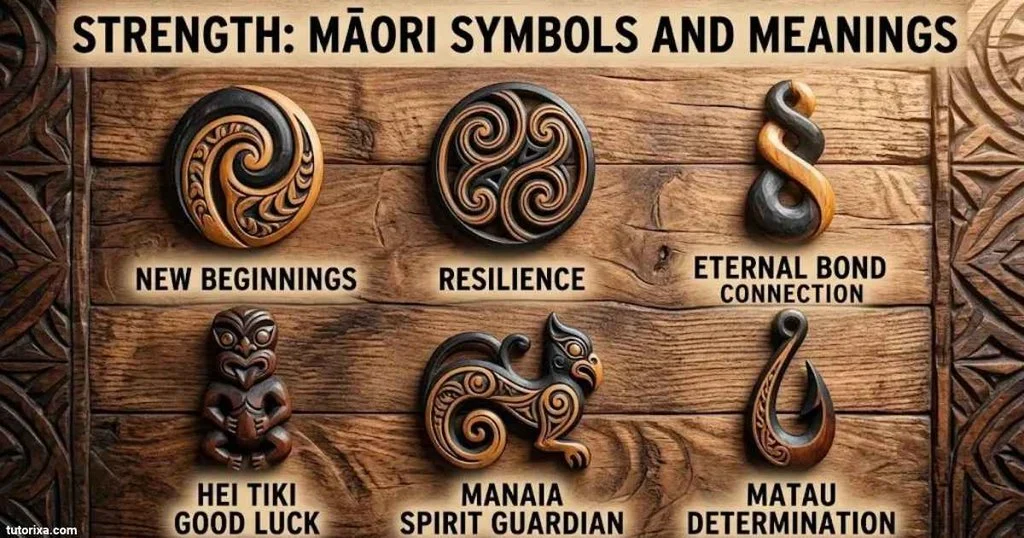
Strength can mean physical power, emotional courage, determination, resilience, and the ability to face difficult situations.
Several Māori designs are associated with these qualities. Some represent personal determination, while others communicate protection, guidance, or the ability to overcome challenges.
Here are some traditional symbols commonly connected with strength.
1. Toki – Strength And Determination
The toki is a particularly suitable design for expressing strength. Its shape is inspired by the traditional adze, a tool associated with skilled work and craftsmanship.
It commonly represents:
- Strength.
- Determination.
- Control.
- Courage.
- Overcoming challenges.
2. Hei Matau – Power And Resilience
The hei matau represents a fishhook and is connected with strength, abundance, and determination.
It is also associated with safe journeys over water, making it meaningful for people who value courage and perseverance.
3. Manaia – Protection And Guidance
The manaia is traditionally associated with spiritual guardianship and guidance. It can communicate the idea of protection and inner strength.
4. Koru – Personal Growth And Resilience
The koru represents new growth and renewal. It can be used in a contemporary personal design to express the ability to recover, learn, and move forward after difficult experiences.
Quick Comparison Of Strength Symbols
| Symbol | Strength-Related Meaning |
| Toki | Determination and control |
| Hei matau | Strength and perseverance |
| Manaia | Spiritual guidance and protection |
| Koru | Growth and renewal |
| Pikorua | Enduring connections |
The best design depends on the kind of strength you want to express. A toki communicates determination, while a koru is more closely associated with personal development.
Māori Symbols And Meanings Tattoos
Māori tattooing is known as tā moko. It is a traditional art form with deep connections to Māori identity, ancestry, personal history, and cultural belonging.
Traditional tā moko is different from an ordinary decorative tattoo. Its designs can communicate a person’s whakapapa, social identity, achievements, and relationships. The meaning of a particular pattern may depend on its placement, structure, and the person wearing it.
Popular Māori-Inspired Tattoo Designs
The following designs are often used as inspiration for contemporary tattoos.
| Design | Common Association |
| Koru | Growth and new beginnings |
| Pikorua | Relationships and connection |
| Manaia | Spiritual guardianship |
| Hei matau | Strength and abundance |
| Toki | Determination and control |
| Roimata | Grief and comfort |
Common Placement Ideas
Contemporary Māori-inspired artwork can appear on different parts of the body, including:
- Forearm: A visible location for a smaller contemporary design.
- Upper arm: Provides space for detailed patterns.
- Shoulder: Suitable for curved compositions.
- Back: Offers a larger area for complex artwork.
- Leg: Can accommodate flowing patterns.
These are general placement ideas, not traditional rules for tā moko.
Tā Moko And Ordinary Tattoos: What Is The Difference?
Tā moko is a culturally significant Māori practice. Its patterns can carry personal and ancestral information, and the art is governed by cultural knowledge and protocols.
An ordinary decorative tattoo may borrow Māori-inspired shapes without having the same cultural meaning or status.
Before choosing a design, consider the following:
- Understand the cultural origins of the pattern.
- Do not assume every Māori design is simply decorative.
- Avoid copying another person’s personal moko.
- Consult a knowledgeable Māori tattoo artist.
- Ask about the meaning and appropriate use of the proposed design.
A tattoo should be more than an attractive collection of lines. Understanding its origins helps ensure that the design is approached with respect.
Māori Symbols And Meanings Tattoos For Females
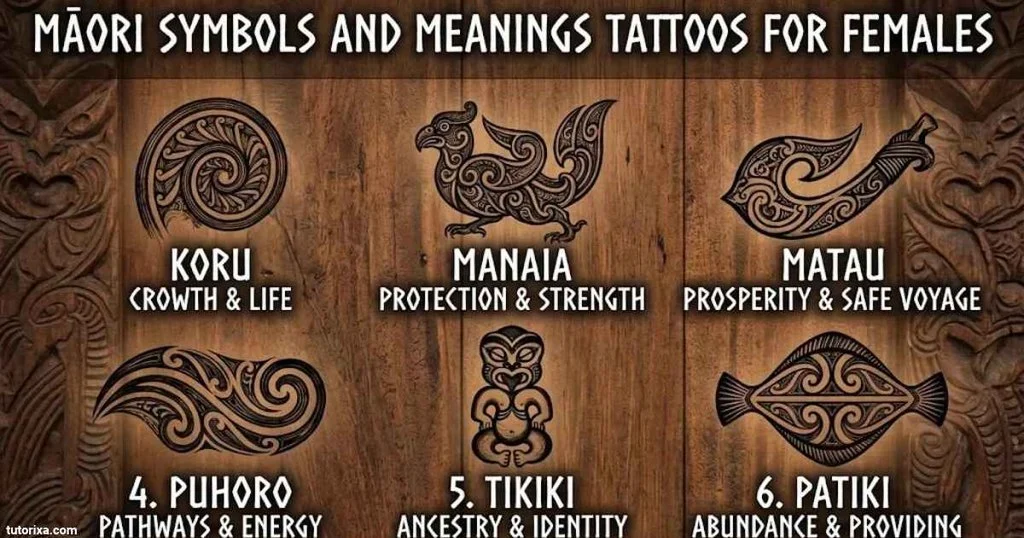
Māori-inspired tattoos for women can include curved patterns, delicate spiral designs, and meaningful compositions that communicate personal stories.
Traditional Māori women have their own important tattooing history. One particularly significant practice is moko kauae, the traditional chin moko worn by Māori women. It is a cultural expression connected with identity, whakapapa, and belonging.
1. Koru Tattoo For Women
The koru is a popular choice for contemporary tattoo inspiration because its curved shape can be adapted into different sizes.
It can communicate:
- New beginnings.
- Personal growth.
- Hope.
- Renewal.
- Positive changes.
2. Pikorua Tattoo For Relationships
The pikorua can express a meaningful connection between two people. It may inspire a contemporary design representing friendship, family bonds, or a lasting relationship.
3. Manaia Tattoo For Protection
Manaia is associated with spiritual guidance and guardianship. Its detailed shape can inspire a larger artistic composition.
4. Roimata Tattoo For Emotional Meaning
Roimata means teardrop and has associations with grief and consolation. It may be meaningful to someone who wants to remember a loved one or acknowledge an important emotional experience.
Popular Placement Inspiration
- Wrist: Small contemporary spiral designs.
- Forearm: Medium-sized flowing patterns.
- Shoulder: Curved decorative compositions.
- Back: Larger artistic designs.
- Ankle: Small personal motifs.
A cultural consideration: Moko kauae is not simply a feminine tattoo style. It is a significant Māori cultural practice. Anyone considering Māori-inspired tattoo artwork should understand the difference between decorative inspiration and culturally specific tā moko.
Māori Symbols And Meanings Tattoos For Guys
Māori-inspired tattoos for men often feature bold shapes, flowing lines, repeated patterns, and detailed compositions.
Traditional tā moko has historically been an important expression of Māori male identity. However, its meaning is personal and culturally specific rather than determined simply by gender.
1. Toki Tattoo – Strength And Determination
The toki is a popular inspiration for people who want to communicate courage, discipline, and determination.
Its adze-inspired shape can work as a standalone design or as part of a larger contemporary composition.
2. Hei Matau Tattoo – Strength And Safe Journeys
The hei matau is associated with abundance, determination, and journeys over water.
It may be meaningful for someone who enjoys the ocean or wants a design connected with perseverance and adventure.
3. Manaia Tattoo – Protection And Guidance
The manaia offers a distinctive design inspired by a traditional spiritual guardian.
It is associated with guidance and protection and can be incorporated into detailed artistic work.
4. Koru Tattoo – Growth And New Beginnings
A koru tattoo can represent personal growth, renewal, and moving forward in life.
Tattoo Placement Inspiration For Men
Some contemporary placement ideas include:
- Full sleeve: A larger composition with multiple flowing elements.
- Shoulder and chest: A broad area for detailed artwork.
- Forearm: Suitable for a medium-sized design.
- Calf: Provides space for vertical patterns.
- Back: Allows for larger compositions.
Remember that traditional tā moko is not interchangeable with generic tribal tattoo designs. A qualified Māori artist can explain the cultural significance of different patterns and help you make an informed choice.
Polynesian Māori Symbols And Meanings Tattoos
Māori art belongs to the wider Polynesian cultural region. Māori ancestors travelled from Eastern Polynesia to Aotearoa, and Māori visual traditions developed over generations in their new homeland.
This history helps explain why Māori and other Polynesian cultures share certain artistic features, including curved lines, geometric patterns, and tattooing traditions.
However, Māori designs are not identical to Samoan, Hawaiian, Tahitian, or other Polynesian designs. Each culture has its own history, language, artistic practices, and meanings.
Common Polynesian And Māori-Inspired Design Elements
| Design Element | Common Association |
| Koru | New growth and renewal |
| Pikorua | Connection and shared journeys |
| Manaia | Spiritual guardianship |
| Hei matau | Strength and abundance |
| Toki | Determination and control |
| Repeated geometric patterns | Meaning depends on the specific cultural tradition |
Māori Art And Other Polynesian Traditions
Here are some important differences to understand:
Māori art: Includes whakairo (carving), kōwhaiwhai (painted patterns), raranga (weaving), and tā moko. Its designs are closely connected with Māori identity, ancestry, and cultural knowledge.
Samoan art: Includes the traditional tatau practice, with established patterns and cultural protocols associated with identity, responsibility, and community.
Hawaiian art: Has its own tattooing and artistic traditions, connected with Hawaiian history, nature, genealogy, and cultural values.
Tahitian art: Includes distinctive Polynesian tattooing patterns and artistic traditions with their own cultural associations.
Choosing A Polynesian-Inspired Tattoo
Before choosing a design, identify which cultural tradition it comes from. Do not combine Māori and other Polynesian patterns randomly simply because they look similar.
If you want an authentic Māori design, seek guidance from a Māori artist who understands traditional imagery and tikanga (cultural protocols).
Drawing Māori Symbols And Meanings
Drawing Māori-inspired symbols can be an enjoyable way to learn about traditional patterns and visual storytelling. However, it is useful to understand what a design represents before reproducing it.
Start with simple shapes, study their origins, and pay attention to the way curved lines and repeated patterns work together.
1. How To Draw A Simple Koru
The koru is a useful starting point because its basic form is a curved spiral.
Follow these steps:
- Draw a small curved line that forms the centre of the spiral.
- Extend the line outward into a larger curve.
- Keep the shape smooth and balanced.
- Add a rounded outer section inspired by an unfurling fern frond.
- Refine the line to create a clean, flowing design.
2. How To Draw A Pikorua
The pikorua is more complex because it contains two intertwined forms.
For a basic drawing exercise:
- Study a reference image of the traditional double twist.
- Sketch two connected curved forms.
- Keep the lines balanced.
- Check that the shapes connect naturally.
- Refine the drawing without changing its overall structure.
3. How To Draw A Manaia
The manaia is a detailed figure, so it helps to begin with a reference from a knowledgeable Māori artist.
Pay attention to its overall form and the relationship between its bird-like, human, and fish-like features.
4. How To Draw A Hei Matau
The hei matau is inspired by a fishhook.
You can begin by studying the curved hook shape, then carefully draw its outer form and refine the details using a traditional reference.
Tips For Drawing Māori-Inspired Designs
- Use clear reference images from reliable cultural sources.
- Learn the meaning of a design before reproducing it.
- Keep curved lines smooth and balanced.
- Avoid combining unrelated cultural patterns.
- Do not copy someone’s personal tā moko.
- Credit Māori artists when using their artwork as a reference.
- Work with a knowledgeable artist when creating designs for public or commercial use.
A simple drawing exercise can help you appreciate the beauty of Māori art. However, copying a traditional motif does not automatically give you an understanding of its cultural significance.
For artwork intended to represent Māori culture, seek guidance from people with relevant cultural knowledge and artistic experience.
Intellectual Property Office of New Zealand+2
Frequently Asked Questions
What Is The Most Popular Māori Symbol?
The koru is among the most recognisable Māori symbols. Inspired by an unfurling fern frond, it represents new beginnings, growth, harmony, and renewal. It is widely seen in contemporary jewellery, artwork, and decorative designs.
What Māori Symbol Represents Family?
There is no single universal Māori family symbol. The pikorua is commonly associated with connection and relationships, while the koru can represent growth and the continuation of life. Whānau and whakapapa are important concepts for understanding Māori family connections.
What Māori Symbol Represents Strength?
The toki is strongly associated with strength, determination, and control. The hei matau is also connected with strength, abundance, and perseverance. The best choice depends on the meaning you want to communicate.
What Does The Māori Koru Symbol Mean In A Tattoo?
A koru tattoo commonly represents growth, new beginnings, renewal, and the journey of life. Its spiral form is inspired by the unfurling silver fern. Its meaning in a particular tattoo can also depend on the artist’s intentions and cultural context.
Is It Respectful For Non-Māori People To Get Māori-Inspired Tattoos?
It requires care and cultural understanding. Decorative inspiration and traditional tā moko are not the same thing. Some designs have specific cultural and personal significance, particularly those connected with ancestry and identity. Consult a knowledgeable Māori artist, understand the design’s origins, and avoid copying personal or culturally restricted moko.
Conclusion
Māori symbols offer a meaningful way to understand the relationship between art, nature, identity, and cultural traditions. Designs such as the koru, pikorua, manaia, hei matau, and toki each have distinctive forms and commonly recognised associations. From new beginnings and family connections to strength and spiritual guidance, these patterns communicate ideas that remain important in Māori art.
If you are exploring these symbols for a tattoo, drawing, jewellery, or personal artwork, take time to understand their origins. A design may look simple, but its cultural background can carry generations of knowledge and meaning. Learning about the differences between traditional Māori art and contemporary Māori-inspired designs will help you make better choices.
The best approach is to appreciate these symbols beyond their appearance. Respect their cultural significance, support Māori artists, and seek guidance when using traditional designs. This allows you to enjoy the beauty of Māori art while recognising the people, stories, and traditions behind it.

I’m Rowan Whitaker, a British writer fascinated by the symbols surrounding us every day. I explore their meanings, origins, cultural significance, and changing interpretations. From ancient marks to modern signs, I enjoy making symbolism easier to understand. My writing helps curious readers discover the hidden messages behind familiar shapes, images, and signs.
Books:
- The Meaning Behind Symbols
- A Modern Guide to Symbolism
 Freddie Beaumont
 Ellis Montgomery